Functions — Question 1

PDF ↗

Question 1

Let f(x)=x+4f(x) = \sqrt{x + 4} and g(x)=1x−2g(x) = \dfrac{1}{x - 2}. Define the composition h(x)=f(g(x))h(x) = f(g(x)).

Find the domain of h(x)h(x), and express your answer in interval notation.

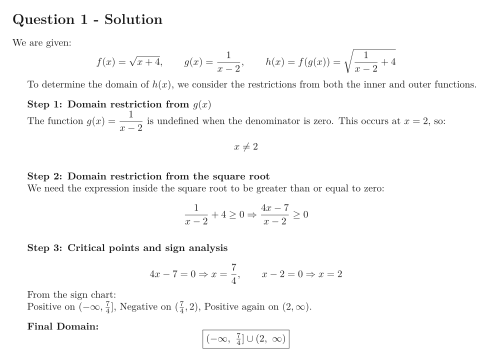
Original worksheet page 1: question and worked solution for 1-1-001
Show solutionHide solution

Question 1 - Solution

We are given: f(x)=x+4,g(x)=1x−2,h(x)=f(g(x))=1x−2+4f(x) = \sqrt{x + 4}, \qquad g(x) = \frac{1}{x - 2}, \qquad h(x) = f(g(x)) = \sqrt{\frac{1}{x - 2} + 4}

To determine the domain of h(x)h(x), we consider the restrictions from both the inner and outer functions.

Step 1: Domain restriction from g(x)g(x)

The function g(x)=1x−2g(x) = \dfrac{1}{x - 2} is undefined when the denominator is zero. This occurs at x=2x = 2, so: x≠2x \neq 2

Step 2: Domain restriction from the square root

We need the expression inside the square root to be greater than or equal to zero: 1x−2+4≥0⇒4x−7x−2≥0\frac{1}{x - 2} + 4 \geq 0 \Rightarrow \frac{4x - 7}{x - 2} \geq 0

Step 3: Critical points and sign analysis

4x−7=0⇒x=74,x−2=0⇒x=24x - 7 = 0 \Rightarrow x = \frac{7}{4}, \qquad x - 2 = 0 \Rightarrow x = 2

From the sign chart:

Positive on (−∞,74](-\infty, \tfrac{7}{4}], Negative on (74,2)(\tfrac{7}{4}, 2), Positive again on (2,∞)(2, \infty).

Final Domain: (−∞,74]∪(2,∞)\boxed{(-\infty,\ \tfrac{7}{4}] \cup (2,\ \infty)}

Original worksheet page 2: question and worked solution for 1-1-001

Original worksheet layout. Use Enlarge or open the PDF for a closer view.