Functions — Question 3

PDF ↗

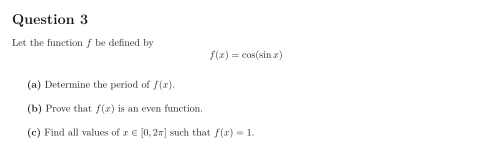
Question 3

Let the function ff be defined by f(x)=cos⁡(sin⁡x)f(x) = \cos(\sin x)

(a) Determine the period of f(x)f(x).

(b) Prove that f(x)f(x) is an even function.

(c) Find all values of x∈[0,2π]x \in [0, 2\pi] such that f(x)=1f(x) = 1.

Original worksheet page 1: question and worked solution for 1-1-003
Show solutionHide solution

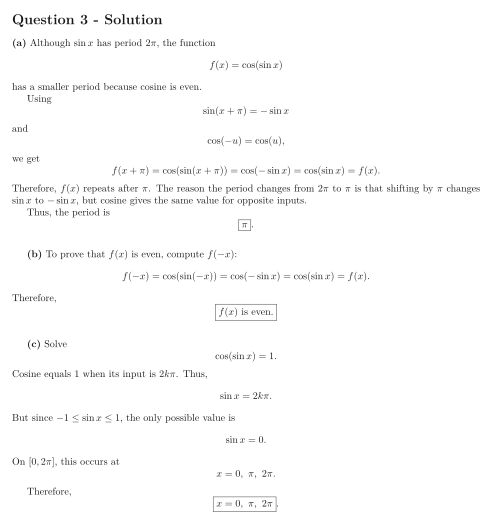
Question 3 - Solution

(a) Although sin⁡x\sin x has period 2π2\pi, the function f(x)=cos⁡(sin⁡x)f(x)=\cos(\sin x) has a smaller period because cosine is even.

Using sin⁡(x+π)=−sin⁡x\sin(x+\pi)=-\sin x and cos⁡(−u)=cos⁡(u),\cos(-u)=\cos(u), we get f(x+π)=cos⁡(sin⁡(x+π))=cos⁡(−sin⁡x)=cos⁡(sin⁡x)=f(x).f(x+\pi) = \cos(\sin(x+\pi)) = \cos(-\sin x) = \cos(\sin x) = f(x). Therefore, f(x)f(x) repeats after π\pi. The reason the period changes from 2π2\pi to π\pi is that shifting by π\pi changes sin⁡x\sin x to −sin⁡x-\sin x, but cosine gives the same value for opposite inputs.

Thus, the period is π.\boxed{\pi}.

(b) To prove that f(x)f(x) is even, compute f(−x)f(-x): f(−x)=cos⁡(sin⁡(−x))=cos⁡(−sin⁡x)=cos⁡(sin⁡x)=f(x).f(-x) = \cos(\sin(-x)) = \cos(-\sin x) = \cos(\sin x) = f(x). Therefore, f(x) is even.\boxed{f(x)\text{ is even}.}

(c) Solve cos⁡(sin⁡x)=1.\cos(\sin x)=1. Cosine equals 11 when its input is 2kπ2k\pi. Thus, sin⁡x=2kπ.\sin x = 2k\pi. But since −1≤sin⁡x≤1-1\leq \sin x \leq 1, the only possible value is sin⁡x=0.\sin x=0. On [0,2π][0,2\pi], this occurs at x=0,π,2π.x=0,\ \pi,\ 2\pi.

Therefore, x=0,π,2π.\boxed{x=0,\ \pi,\ 2\pi}.

Original worksheet page 2: question and worked solution for 1-1-003

Original worksheet layout. Use Enlarge or open the PDF for a closer view.