Question 7
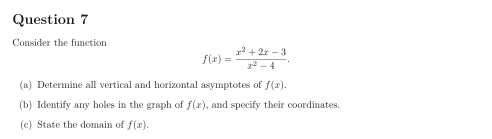
Consider the function
(a) Determine all vertical and horizontal asymptotes of .
(b) Identify any holes in the graph of , and specify their coordinates.
(c) State the domain of .
Show solutionHide solution
Question 7 - Solution
We are given Factor the numerator and denominator:
(a) Vertical asymptotes occur where the denominator is zero and no factor cancels. Since the denominator is zero at There are no common factors with the numerator, so both are vertical asymptotes:
Since the numerator and denominator have the same degree, the horizontal asymptote is the ratio of leading coefficients: Thus,
(b) Holes occur when a factor cancels from the numerator and denominator. Since has no common factors, there are
(c) The domain excludes the values that make the denominator zero: Therefore,
See the diagram in the original worksheet below.
