Functions — Question 10

PDF ↗

Question 10

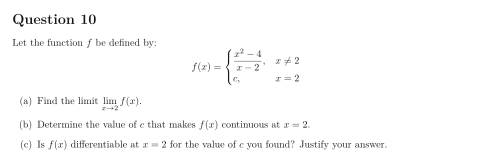
Let the function ff be defined by: f(x)={x2−4x−2,x≠2c,x=2f(x) = \begin{cases} \dfrac{x^2 - 4}{x - 2}, & x \neq 2 \\ c, & x = 2 \end{cases}

  • (a) Find the limit limx→2f(x)\lim\limits_{x \to 2} f(x).

  • (b) Determine the value of cc that makes f(x)f(x) continuous at x=2x = 2.

  • (c) Is f(x)f(x) differentiable at x=2x = 2 for the value of cc you found? Justify your answer.

Original worksheet page 1: question and worked solution for 1-1-010
Show solutionHide solution

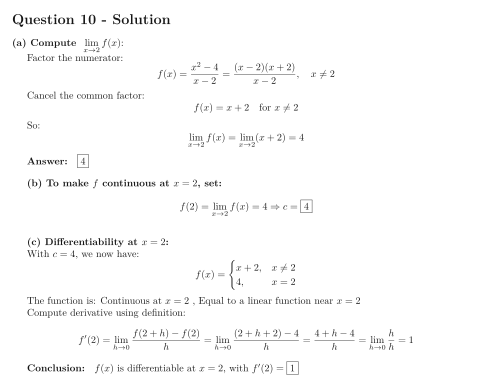
Question 10 - Solution

(a) Compute limx→2f(x)\lim\limits_{x \to 2} f(x):

Factor the numerator: f(x)=x2−4x−2=(x−2)(x+2)x−2,x≠2f(x) = \frac{x^2 - 4}{x - 2} = \frac{(x - 2)(x + 2)}{x - 2}, \quad x \neq 2

Cancel the common factor: f(x)=x+2for x≠2f(x) = x + 2 \quad \text{for } x \neq 2

So: limx→2f(x)=limx→2(x+2)=4\lim_{x \to 2} f(x) = \lim_{x \to 2} (x + 2) = 4

Answer: 4\boxed{4}

(b) To make ff continuous at x=2x = 2, set: f(2)=limx→2f(x)=4⇒c=4f(2) = \lim_{x \to 2} f(x) = 4 \Rightarrow c = \boxed{4}

(c) Differentiability at x=2x = 2:

With c=4c = 4, we now have: f(x)={x+2,x≠24,x=2f(x) = \begin{cases} x + 2, & x \neq 2 \\ 4, & x = 2 \end{cases}

The function is: Continuous at x=2x = 2 , Equal to a linear function near x=2x = 2

Compute derivative using definition: f′(2)=limh→0f(2+h)−f(2)h=limh→0(2+h+2)−4h=4+h−4h=limh→0hh=1f'(2) = \lim_{h \to 0} \frac{f(2 + h) - f(2)}{h} = \lim_{h \to 0} \frac{(2 + h + 2) - 4}{h} = \frac{4 + h - 4}{h} = \lim_{h \to 0} \frac{h}{h} = 1

Conclusion: f(x)f(x) is differentiable at x=2x = 2, with f′(2)=1f'(2) = \boxed{1}

Original worksheet page 2: question and worked solution for 1-1-010

Original worksheet layout. Use Enlarge or open the PDF for a closer view.