Inverse Functions — Question 2

PDF ↗

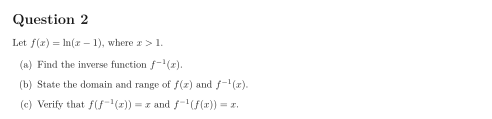
Question 2

Let f(x)=ln⁡(x−1)f(x) = \ln(x - 1), where x>1x > 1.

  • (a) Find the inverse function f−1(x)f^{-1}(x).

  • (b) State the domain and range of f(x)f(x) and f−1(x)f^{-1}(x).

  • (c) Verify that f(f−1(x))=xf(f^{-1}(x)) = x and f−1(f(x))=xf^{-1}(f(x)) = x.

Original worksheet page 1: question and worked solution for 1-2-002
Show solutionHide solution

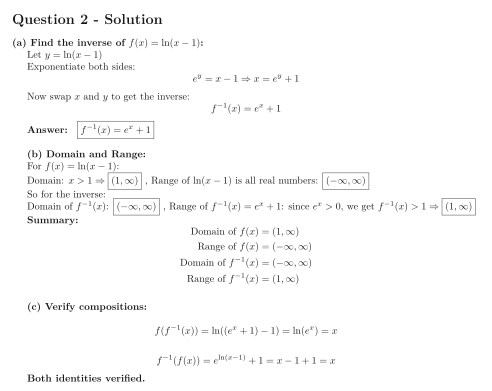
Question 2 - Solution

(a) Find the inverse of f(x)=ln⁡(x−1)f(x) = \ln(x - 1):

Let y=ln⁡(x−1)y = \ln(x - 1)

Exponentiate both sides: ey=x−1⇒x=ey+1e^y = x - 1 \Rightarrow x = e^y + 1

Now swap xx and yy to get the inverse: f−1(x)=ex+1f^{-1}(x) = e^x + 1

Answer: f−1(x)=ex+1\boxed{f^{-1}(x) = e^x + 1}

(b) Domain and Range:

For f(x)=ln⁡(x−1)f(x) = \ln(x - 1):

Domain: x>1⇒(1,∞)x > 1 \Rightarrow \boxed{(1, \infty)} , Range of ln⁡(x−1)\ln(x - 1) is all real numbers: (−∞,∞)\boxed{(-\infty, \infty)}

So for the inverse:

Domain of f−1(x)f^{-1}(x): (−∞,∞)\boxed{(-\infty, \infty)} , Range of f−1(x)=ex+1f^{-1}(x) = e^x + 1: since ex>0e^x > 0, we get f−1(x)>1⇒(1,∞)f^{-1}(x) > 1 \Rightarrow \boxed{(1, \infty)}

Summary: Domain of f(x)=(1,∞)Range of f(x)=(−∞,∞)Domain of f−1(x)=(−∞,∞)Range of f−1(x)=(1,∞)\begin{aligned} \text{Domain of } f(x) &= (1, \infty) \\ \text{Range of } f(x) &= (-\infty, \infty) \\ \text{Domain of } f^{-1}(x) &= (-\infty, \infty) \\ \text{Range of } f^{-1}(x) &= (1, \infty) \end{aligned}

(c) Verify compositions:

f(f−1(x))=ln⁡((ex+1)−1)=ln⁡(ex)=xf(f^{-1}(x)) = \ln((e^x + 1) - 1) = \ln(e^x) = x

f−1(f(x))=eln⁡(x−1)+1=x−1+1=xf^{-1}(f(x)) = e^{\ln(x - 1)} + 1 = x - 1 + 1 = x

Both identities verified.

Original worksheet page 2: question and worked solution for 1-2-002

Original worksheet layout. Use Enlarge or open the PDF for a closer view.