Inverse Functions — Question 10

PDF ↗

Question 10

Let f(x)=x+4x−1f(x) = \frac{\sqrt{x + 4}}{x - 1}

  • (a) Determine the domain of f(x)f(x).

  • (b) Is ff one-to-one on its domain? Justify your answer.

  • (c) If possible, find f−1(x)f^{-1}(x). If not, restrict the domain appropriately and find the inverse on that domain.
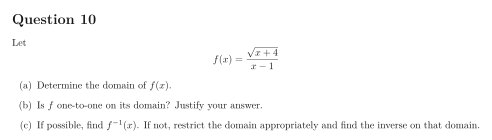
Original worksheet page 1: question and worked solution for 1-2-010
Show solutionHide solution

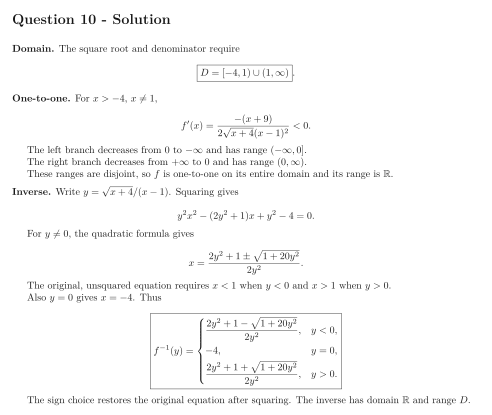
Question 10 - Solution

Domain. The square root and denominator require

D=[−4,1)∪(1,∞).\boxed{D=[-4,1)\cup(1,\infty)}.

One-to-one. For x>−4x>-4, x≠1x\ne1,

f′(x)=−(x+9)2x+4(x−1)2<0.f'(x)=\frac{-(x+9)}{2\sqrt{x+4}(x-1)^2}<0.

The left branch decreases from 00 to −∞-\infty and has range (−∞,0](-\infty,0].

The right branch decreases from +∞+\infty to 00 and has range (0,∞)(0,\infty).

These ranges are disjoint, so ff is one-to-one on its entire domain and its range is ℝ\mathbb R.

Inverse. Write y=x+4/(x−1)y=\sqrt{x+4}/(x-1). Squaring gives

y2x2−(2y2+1)x+y2−4=0.y^2x^2-(2y^2+1)x+y^2-4=0.

For y≠0y\ne0, the quadratic formula gives

x=2y2+1±1+20y22y2.x=\frac{2y^2+1\pm\sqrt{1+20y^2}}{2y^2}.

The original, unsquared equation requires x<1x<1 when y<0y<0 and x>1x>1 when y>0y>0.

Also y=0y=0 gives x=−4x=-4. Thus

f−1(y)={2y2+1−1+20y22y2,y<0,−4,y=0,2y2+1+1+20y22y2,y>0.\boxed{f^{-1}(y)=\begin{cases} \dfrac{2y^2+1-\sqrt{1+20y^2}}{2y^2},&y<0,\\[6pt] -4,&y=0,\\[3pt] \dfrac{2y^2+1+\sqrt{1+20y^2}}{2y^2},&y>0. \end{cases}}

The sign choice restores the original equation after squaring. The inverse has domain ℝ\mathbb R and range DD.

Original worksheet page 2: question and worked solution for 1-2-010

Original worksheet layout. Use Enlarge or open the PDF for a closer view.