Trig Functions — Question 1

PDF ↗

Question 1

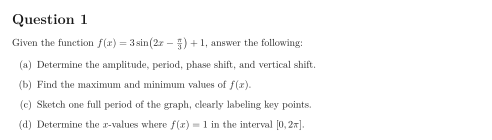
Given the function f(x)=3sin⁡(2x−π3)+1f(x) = 3\sin\!\left(2x - \frac{\pi}{3}\right) + 1, answer the following:

  • (a) Determine the amplitude, period, phase shift, and vertical shift.

  • (b) Find the maximum and minimum values of f(x)f(x).

  • (c) Sketch one full period of the graph, clearly labeling key points.

  • (d) Determine the xx-values where f(x)=1f(x) = 1 in the interval [0,2π][0, 2\pi].

Original worksheet page 1: question and worked solution for 1-3-001
Show solutionHide solution

Question 1 - Solution

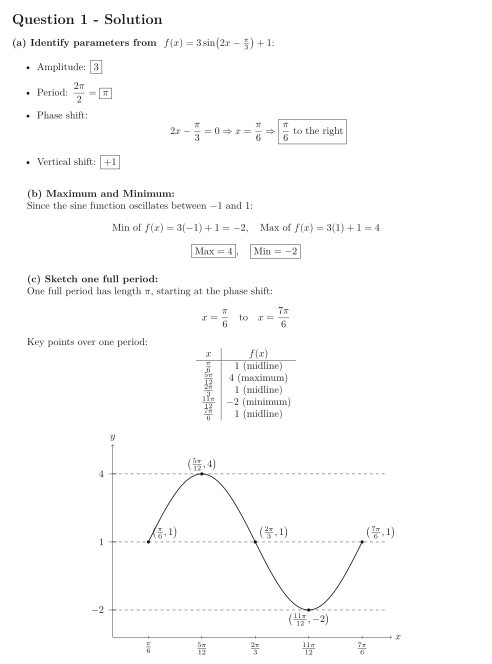
(a) Identify parameters from f(x)=3sin⁡(2x−π3)+1f(x) = 3\sin\!\left(2x - \frac{\pi}{3}\right) + 1:

  • Amplitude: 3\boxed{3}

  • Period: 2π2=π\dfrac{2\pi}{2} = \boxed{\pi}

  • Phase shift: 2x−π3=0⇒x=π6⇒π6 to the right2x - \frac{\pi}{3} = 0 \Rightarrow x = \frac{\pi}{6} \Rightarrow \boxed{\frac{\pi}{6} \text{ to the right}}

  • Vertical shift: +1\boxed{+1}

(b) Maximum and Minimum:

Since the sine function oscillates between −1-1 and 11: Min of f(x)=3(−1)+1=−2,Max of f(x)=3(1)+1=4\text{Min of } f(x) = 3(-1) + 1 = -2, \quad \text{Max of } f(x) = 3(1) + 1 = 4 Max=4,Min=−2\boxed{\text{Max} = 4}, \quad \boxed{\text{Min} = -2}

(c) Sketch one full period:

One full period has length π\pi, starting at the phase shift: x=π6tox=7π6x = \frac{\pi}{6} \quad \text{to} \quad x = \frac{7\pi}{6}

Key points over one period: xf(x)π61(midline)5π124(maximum)2π31(midline)11π12−2(minimum)7π61(midline)\begin{array}{c|c} x & f(x) \\ \hline \frac{\pi}{6} & 1 \ (\text{midline}) \\ \frac{5\pi}{12} & 4 \ (\text{maximum}) \\ \frac{2\pi}{3} & 1 \ (\text{midline}) \\ \frac{11\pi}{12} & -2 \ (\text{minimum}) \\ \frac{7\pi}{6} & 1 \ (\text{midline}) \end{array}

See the diagram in the original worksheet below.

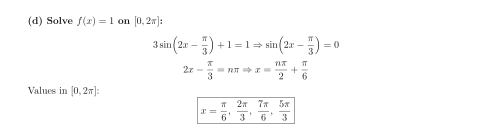
(d) Solve f(x)=1f(x) = 1 on [0,2π][0, 2\pi]:

3sin⁡(2x−π3)+1=1⇒sin⁡(2x−π3)=03\sin\!\left(2x - \frac{\pi}{3}\right) + 1 = 1 \Rightarrow \sin\!\left(2x - \frac{\pi}{3}\right) = 0 2x−π3=nπ⇒x=nπ2+π62x - \frac{\pi}{3} = n\pi \Rightarrow x = \frac{n\pi}{2} + \frac{\pi}{6}

Values in [0,2π][0, 2\pi]: x=π6,2π3,7π6,5π3\boxed{ x = \frac{\pi}{6},\ \frac{2\pi}{3},\ \frac{7\pi}{6},\ \frac{5\pi}{3} }

Original worksheet page 2: question and worked solution for 1-3-001
Original worksheet page 3: question and worked solution for 1-3-001

Original worksheet layout. Use Enlarge or open the PDF for a closer view.