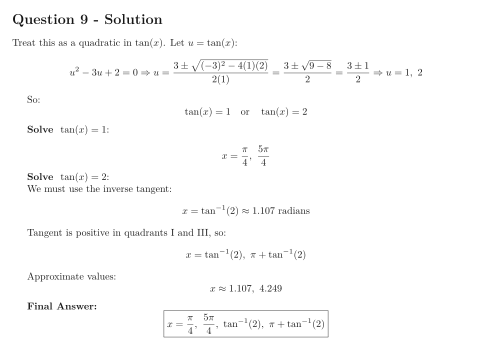
Question 9 Solve the equation tan2(x)−3tan(x)+2=0\tan^2(x) - 3\tan(x) + 2 = 0 for all x∈[0,2π)x \in [0, 2\pi). Show solutionHide solution+Question 9 - Solution Treat this as a quadratic in tan(x)\tan(x). Let u=tan(x)u = \tan(x): u2−3u+2=0⇒u=3±(−3)2−4(1)(2)2(1)=3±9−82=3±12⇒u=1,2u^2 - 3u + 2 = 0 \Rightarrow u = \frac{3 \pm \sqrt{(-3)^2 - 4(1)(2)}}{2(1)} = \frac{3 \pm \sqrt{9 - 8}}{2} = \frac{3 \pm 1}{2} \Rightarrow u = 1,\ 2 So: tan(x)=1ortan(x)=2\tan(x) = 1 \quad \text{or} \quad \tan(x) = 2 Solve tan(x)=1\tan(x) = 1: x=π4,5π4x = \frac{\pi}{4},\ \frac{5\pi}{4} Solve tan(x)=2\tan(x) = 2: We must use the inverse tangent: x=tan−1(2)≈1.107 radiansx = \tan^{-1}(2) \approx 1.107 \text{ radians} Tangent is positive in quadrants I and III, so: x=tan−1(2),π+tan−1(2)x = \tan^{-1}(2),\ \pi + \tan^{-1}(2) Approximate values: x≈1.107,4.249x \approx 1.107,\ 4.249 Final Answer: x=π4,5π4,tan−1(2),π+tan−1(2)\boxed{ x = \frac{\pi}{4},\ \frac{5\pi}{4},\ \tan^{-1}(2),\ \pi + \tan^{-1}(2) }