Logarithm Functions — Question 5

PDF ↗

Question 5

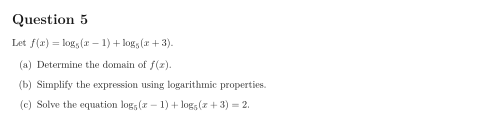
Let f(x)=log⁡5(x−1)+log⁡5(x+3)f(x) = \log_5(x - 1) + \log_5(x + 3).

  • (a) Determine the domain of f(x)f(x).

  • (b) Simplify the expression using logarithmic properties.

  • (c) Solve the equation log⁡5(x−1)+log⁡5(x+3)=2\log_5(x - 1) + \log_5(x + 3) = 2.

Original worksheet page 1: question and worked solution for 1-8-005
Show solutionHide solution

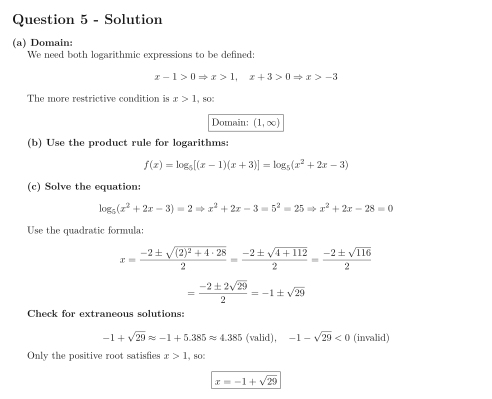
Question 5 - Solution

(a) Domain:

We need both logarithmic expressions to be defined: x−1>0⇒x>1,x+3>0⇒x>−3x - 1 > 0 \Rightarrow x > 1,\quad x + 3 > 0 \Rightarrow x > -3

The more restrictive condition is x>1x > 1, so:

Domain: (1,∞)\boxed{\text{Domain: } (1, \infty)}

(b) Use the product rule for logarithms: f(x)=log⁡5[(x−1)(x+3)]=log⁡5(x2+2x−3)f(x) = \log_5[(x - 1)(x + 3)] = \log_5(x^2 + 2x - 3)

(c) Solve the equation: log⁡5(x2+2x−3)=2⇒x2+2x−3=52=25⇒x2+2x−28=0\log_5(x^2 + 2x - 3) = 2 \Rightarrow x^2 + 2x - 3 = 5^2 = 25 \Rightarrow x^2 + 2x - 28 = 0

Use the quadratic formula: x=−2±(2)2+4⋅282=−2±4+1122=−2±1162x = \frac{-2 \pm \sqrt{(2)^2 + 4 \cdot 28}}{2} = \frac{-2 \pm \sqrt{4 + 112}}{2} = \frac{-2 \pm \sqrt{116}}{2} =−2±2292=−1±29= \frac{-2 \pm 2\sqrt{29}}{2} = -1 \pm \sqrt{29}

Check for extraneous solutions:

−1+29≈−1+5.385≈4.385(valid),−1−29<0(invalid)-1 + \sqrt{29} \approx -1 + 5.385 \approx 4.385\ (\text{valid}),\quad -1 - \sqrt{29} < 0\ (\text{invalid})

Only the positive root satisfies x>1x > 1, so:

x=−1+29\boxed{x = -1 + \sqrt{29}}

Original worksheet page 2: question and worked solution for 1-8-005

Original worksheet layout. Use Enlarge or open the PDF for a closer view.