Exponential and Logarithm Equations — Question 5

PDF ↗

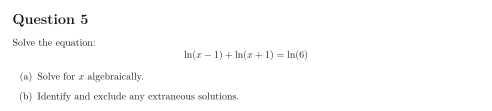
Question 5

Solve the equation: ln⁡(x−1)+ln⁡(x+1)=ln⁡(6)\ln(x - 1) + \ln(x + 1) = \ln(6)

  • (a) Solve for xx algebraically.

  • (b) Identify and exclude any extraneous solutions.

Original worksheet page 1: question and worked solution for 1-9-005
Show solutionHide solution

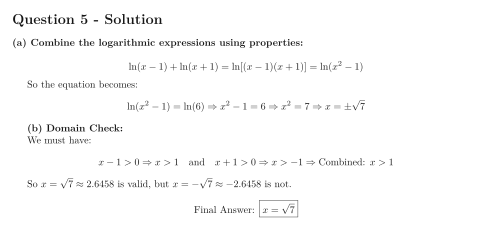
Question 5 - Solution

(a) Combine the logarithmic expressions using properties:

ln⁡(x−1)+ln⁡(x+1)=ln⁡[(x−1)(x+1)]=ln⁡(x2−1)\ln(x - 1) + \ln(x + 1) = \ln[(x - 1)(x + 1)] = \ln(x^2 - 1)

So the equation becomes: ln⁡(x2−1)=ln⁡(6)⇒x2−1=6⇒x2=7⇒x=±7\ln(x^2 - 1) = \ln(6) \Rightarrow x^2 - 1 = 6 \Rightarrow x^2 = 7 \Rightarrow x = \pm \sqrt{7}

(b) Domain Check:

We must have: x−1>0⇒x>1andx+1>0⇒x>−1⇒Combined: x>1x - 1 > 0 \Rightarrow x > 1 \quad\text{and}\quad x + 1 > 0 \Rightarrow x > -1 \Rightarrow \text{Combined: } x > 1

So x=7≈2.6458x = \sqrt{7} \approx 2.6458 is valid, but x=−7≈−2.6458x = -\sqrt{7} \approx -2.6458 is not.

Final Answer: x=7\text{Final Answer: } \boxed{x = \sqrt{7}}

Original worksheet page 2: question and worked solution for 1-9-005

Original worksheet layout. Use Enlarge or open the PDF for a closer view.