Tangent Lines and Rates of Change — Question 4

PDF ↗

Question 4

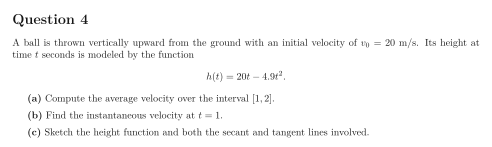
A ball is thrown vertically upward from the ground with an initial velocity of v0=20v_0 = 20 m/s. Its height at time tt seconds is modeled by the function h(t)=20t−4.9t2.h(t) = 20t - 4.9t^2.

(a) Compute the average velocity over the interval [1,2][1, 2].

(b) Find the instantaneous velocity at t=1t = 1.

(c) Sketch the height function and both the secant and tangent lines involved.
Original worksheet page 1: question and worked solution for 2-1-004
Show solutionHide solution

Question 4 - Solution

Given: h(t)=20t−4.9t2h(t) = 20t - 4.9t^2

(a) Average velocity on [1,2][1, 2]: h(1)=20(1)−4.9(1)2=20−4.9=15.1h(1) = 20(1) - 4.9(1)^2 = 20 - 4.9 = 15.1 h(2)=20(2)−4.9(4)=40−19.6=20.4h(2) = 20(2) - 4.9(4) = 40 - 19.6 = 20.4 Average velocity=20.4−15.12−1=5.3 m/s\text{Average velocity} = \frac{20.4 - 15.1}{2 - 1} = 5.3 \text{ m/s}

(b) Instantaneous velocity at t=1t = 1: h′(t)=20−9.8t⇒h′(1)=20−9.8=10.2 m/sh'(t) = 20 - 9.8t \quad \Rightarrow \quad h'(1) = 20 - 9.8 = 10.2 \text{ m/s}

(c) Interpretation: The ball’s velocity at exactly t=1t = 1 is greater than the average velocity over the interval, indicating it is still on the way up. Below is the sketch of the graph.

See the diagram in the original worksheet below.

Original worksheet page 2: question and worked solution for 2-1-004

Original worksheet layout. Use Enlarge or open the PDF for a closer view.