Tangent Lines and Rates of Change — Question 6
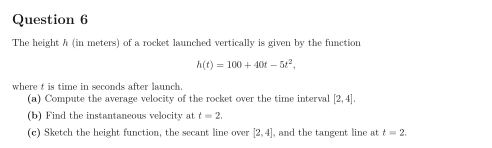
Question 6
The height
(in meters) of a rocket launched vertically is given by the function
where
is time in seconds after launch.
(a) Compute the average velocity of the rocket over
the time interval
.
(b) Find the instantaneous velocity at
.
(c) Sketch the height function, the secant line over
,
and the tangent line at
.
Show solutionHide solution+
Question 6 -
Solution
Given:
(a) Average velocity on
:
(b) Instantaneous velocity at
:
(c) Interpretation: At
,
the rocket is climbing at a rate of 20 m/s, which is faster than its
average velocity between
and
.
See the diagram in the original worksheet below.
Original worksheet layout. Use Enlarge or open the PDF for a closer view.