Tangent Lines and Rates of Change — Question 8

PDF ↗

Question 8

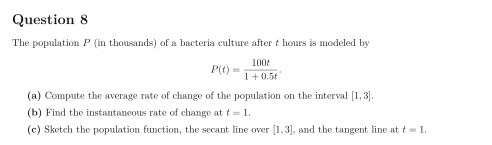
The population PP (in thousands) of a bacteria culture after tt hours is modeled by P(t)=100t1+0.5t.P(t) = \frac{100t}{1 + 0.5t}.

(a) Compute the average rate of change of the population on the interval [1,3][1, 3].

(b) Find the instantaneous rate of change at t=1t = 1.

(c) Sketch the population function, the secant line over [1,3][1, 3], and the tangent line at t=1t = 1.

Original worksheet page 1: question and worked solution for 2-1-008
Show solutionHide solution

Question 8 - Solution

Given: P(t)=100t1+0.5tP(t) = \frac{100t}{1 + 0.5t}

(a) Average rate of change on [1,3][1, 3]: P(1)=100(1)1+0.5(1)=1001.5≈66.67P(1) = \frac{100(1)}{1 + 0.5(1)} = \frac{100}{1.5} \approx 66.67 P(3)=100(3)1+0.5(3)=3002.5=120P(3) = \frac{100(3)}{1 + 0.5(3)} = \frac{300}{2.5} = 120 Average rate=120−66.673−1=53.332=26.67 thousand/hour\text{Average rate} = \frac{120 - 66.67}{3 - 1} = \frac{53.33}{2} = 26.67 \text{ thousand/hour}

(b) Instantaneous rate of change at t=1t = 1:

Use the quotient rule: P′(t)=(1+0.5t)(100)−100t(0.5)(1+0.5t)2=100+50t−50t(1+0.5t)2=100(1+0.5t)2P'(t) = \frac{(1 + 0.5t)(100) - 100t(0.5)}{(1 + 0.5t)^2} = \frac{100 + 50t - 50t}{(1 + 0.5t)^2} = \frac{100}{(1 + 0.5t)^2}

P′(1)=100(1+0.5)2=1002.25≈44.44 thousand/hourP'(1) = \frac{100}{(1 + 0.5)^2} = \frac{100}{2.25} \approx 44.44 \text{ thousand/hour}

(c) Interpretation: The population is increasing more rapidly at t=1t = 1 than the average over the interval. The tangent line shows the instantaneous trend, and the secant line reflects the average change.

See the diagram in the original worksheet below.

Original worksheet page 2: question and worked solution for 2-1-008

Original worksheet layout. Use Enlarge or open the PDF for a closer view.