Tangent Lines and Rates of Change — Question 10

PDF ↗

Question 10

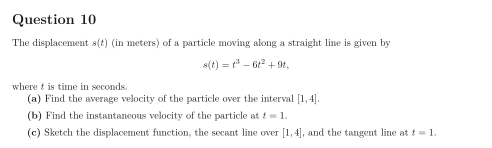
The displacement s(t)s(t) (in meters) of a particle moving along a straight line is given by s(t)=t3−6t2+9t,s(t) = t^3 - 6t^2 + 9t, where tt is time in seconds.

(a) Find the average velocity of the particle over the interval [1,4][1, 4].

(b) Find the instantaneous velocity of the particle at t=1t = 1.

(c) Sketch the displacement function, the secant line over [1,4][1, 4], and the tangent line at t=1t = 1.

Original worksheet page 1: question and worked solution for 2-1-010
Show solutionHide solution

Question 10 - Solution

Given: s(t)=t3−6t2+9ts(t) = t^3 - 6t^2 + 9t

(a) Average velocity on [1,4][1, 4]: s(1)=13−6(1)2+9(1)=1−6+9=4s(1) = 1^3 - 6(1)^2 + 9(1) = 1 - 6 + 9 = 4 s(4)=64−96+36=4s(4) = 64 - 96 + 36 = 4 Average velocity=4−44−1=0 m/s\text{Average velocity} = \frac{4 - 4}{4 - 1} = 0 \text{ m/s}

(b) Instantaneous velocity at t=1t = 1: s′(t)=3t2−12t+9⇒s′(1)=3(1)2−12(1)+9=3−12+9=0 m/ss'(t) = 3t^2 - 12t + 9 \quad \Rightarrow \quad s'(1) = 3(1)^2 - 12(1) + 9 = 3 - 12 + 9 = 0 \text{ m/s}

(c) Interpretation: The average and instantaneous velocities are both zero, indicating the particle returns to its starting displacement at t=4t = 4, and is momentarily at rest at t=1t = 1.

See the diagram in the original worksheet below.

Original worksheet page 2: question and worked solution for 2-1-010

Original worksheet layout. Use Enlarge or open the PDF for a closer view.