The Limit — Question 8

PDF ↗

Question 8

Evaluate the following limit: limx→0e2x−1sin⁡(3x)\lim_{x \to 0} \frac{e^{2x} - 1}{\sin(3x)}

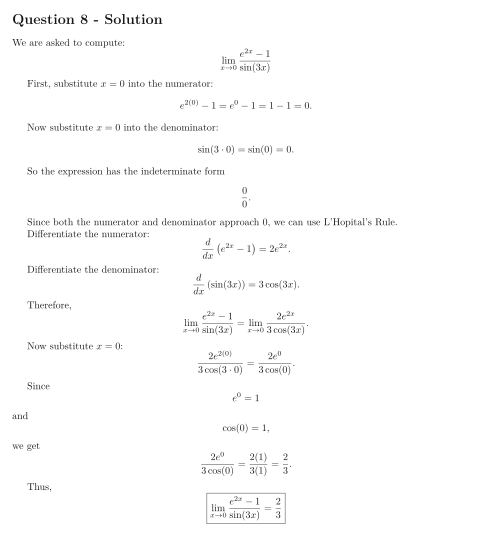
Original worksheet page 1: question and worked solution for 2-2-008
Show solutionHide solution

Question 8 - Solution

We are asked to compute: limx→0e2x−1sin⁡(3x)\lim_{x \to 0} \frac{e^{2x} - 1}{\sin(3x)}

First, substitute x=0x = 0 into the numerator: e2(0)−1=e0−1=1−1=0.e^{2(0)} - 1 = e^0 - 1 = 1 - 1 = 0.

Now substitute x=0x = 0 into the denominator: sin⁡(3⋅0)=sin⁡(0)=0.\sin(3 \cdot 0) = \sin(0) = 0.

So the expression has the indeterminate form 00.\frac{0}{0}.

Since both the numerator and denominator approach 00, we can use L’Hopital’s Rule.

Differentiate the numerator: ddx(e2x−1)=2e2x.\frac{d}{dx}\left(e^{2x} - 1\right) = 2e^{2x}.

Differentiate the denominator: ddx(sin(3x))=3cos⁡(3x).\frac{d}{dx}\left(\sin(3x)\right) = 3\cos(3x).

Therefore, limx→0e2x−1sin⁡(3x)=limx→02e2x3cos⁡(3x).\lim_{x \to 0} \frac{e^{2x} - 1}{\sin(3x)} = \lim_{x \to 0} \frac{2e^{2x}}{3\cos(3x)}.

Now substitute x=0x = 0: 2e2(0)3cos⁡(3⋅0)=2e03cos⁡(0).\frac{2e^{2(0)}}{3\cos(3 \cdot 0)} = \frac{2e^0}{3\cos(0)}.

Since e0=1e^0 = 1 and cos⁡(0)=1,\cos(0) = 1, we get 2e03cos⁡(0)=2(1)3(1)=23.\frac{2e^0}{3\cos(0)} = \frac{2(1)}{3(1)} = \frac{2}{3}.

Thus, limx→0e2x−1sin⁡(3x)=23\boxed{ \lim_{x \to 0} \frac{e^{2x} - 1}{\sin(3x)} = \frac{2}{3} }

Original worksheet page 2: question and worked solution for 2-2-008

Original worksheet layout. Use Enlarge or open the PDF for a closer view.