One–Sided Limits — Question 8

PDF ↗

Question 8

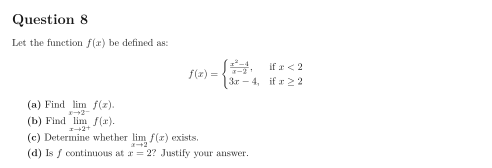
Let the function f(x)f(x) be defined as: f(x)={x2−4x−2,if x<23x−4,if x≥2f(x) = \begin{cases} \frac{x^2 - 4}{x - 2}, & \text{if } x < 2 \\ 3x - 4, & \text{if } x \geq 2 \end{cases}

(a) Find lim⁡x→2−f(x)\displaystyle\lim_{x \to 2^-} f(x).

(b) Find lim⁡x→2+f(x)\displaystyle\lim_{x \to 2^+} f(x).

(c) Determine whether lim⁡x→2f(x)\displaystyle\lim_{x \to 2} f(x) exists.

(d) Is ff continuous at x=2x = 2? Justify your answer.

Original worksheet page 1: question and worked solution for 2-3-008
Show solutionHide solution

Question 8 - Solution

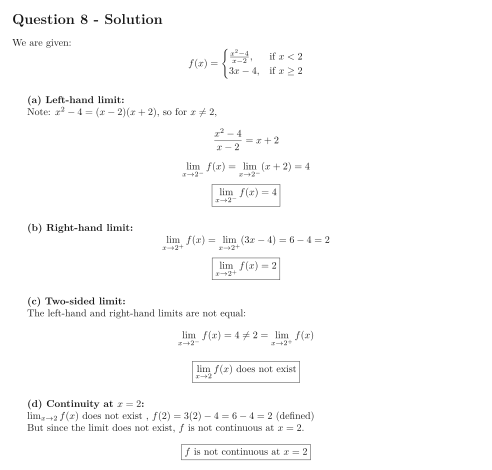
We are given: f(x)={x2−4x−2,if x<23x−4,if x≥2f(x) = \begin{cases} \frac{x^2 - 4}{x - 2}, & \text{if } x < 2 \\ 3x - 4, & \text{if } x \geq 2 \end{cases}

(a) Left-hand limit:

Note: x2−4=(x−2)(x+2)x^2 - 4 = (x - 2)(x + 2), so for x≠2x \neq 2, x2−4x−2=x+2\frac{x^2 - 4}{x - 2} = x + 2 limx→2−f(x)=limx→2−(x+2)=4\lim_{x \to 2^-} f(x) = \lim_{x \to 2^-} (x + 2) = 4 limx→2−f(x)=4\boxed{\lim_{x \to 2^-} f(x) = 4}

(b) Right-hand limit: limx→2+f(x)=limx→2+(3x−4)=6−4=2\lim_{x \to 2^+} f(x) = \lim_{x \to 2^+} (3x - 4) = 6 - 4 = 2 limx→2+f(x)=2\boxed{\lim_{x \to 2^+} f(x) = 2}

(c) Two-sided limit:

The left-hand and right-hand limits are not equal: limx→2−f(x)=4≠2=limx→2+f(x)\lim_{x \to 2^-} f(x) = 4 \neq 2 = \lim_{x \to 2^+} f(x)

limx→2f(x) does not exist\boxed{\lim_{x \to 2} f(x) \text{ does not exist}}

(d) Continuity at x=2x = 2:

lim⁡x→2f(x)\lim_{x \to 2} f(x) does not exist , f(2)=3(2)−4=6−4=2f(2) = 3(2) - 4 = 6 - 4 = 2 (defined)

But since the limit does not exist, ff is not continuous at x=2x = 2.

f is not continuous at x=2\boxed{f \text{ is not continuous at } x = 2}

Original worksheet page 2: question and worked solution for 2-3-008

Original worksheet layout. Use Enlarge or open the PDF for a closer view.