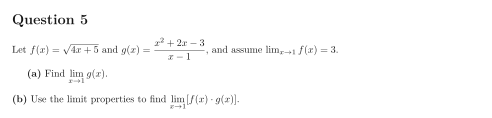
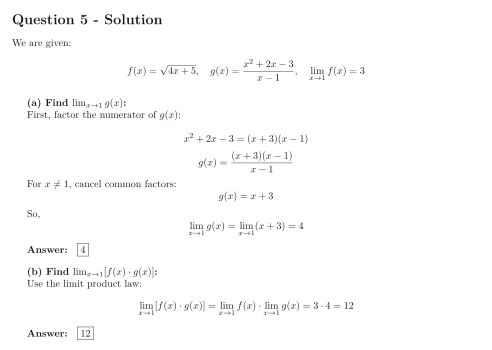
Question 5 Let f(x)=4x+5f(x) = \sqrt{4x + 5} and g(x)=x2+2x−3x−1g(x) = \dfrac{x^2 + 2x - 3}{x - 1}, and assume limx→1f(x)=3\lim_{x \to 1} f(x) = 3. (a) Find limx→1g(x)\displaystyle \lim_{x \to 1} g(x). (b) Use the limit properties to find limx→1[f(x)⋅g(x)]\displaystyle \lim_{x \to 1} [f(x) \cdot g(x)]. Show solutionHide solution+Question 5 - Solution We are given: f(x)=4x+5,g(x)=x2+2x−3x−1,limx→1f(x)=3f(x) = \sqrt{4x + 5}, \quad g(x) = \dfrac{x^2 + 2x - 3}{x - 1}, \quad \lim_{x \to 1} f(x) = 3 (a) Find limx→1g(x)\lim_{x \to 1} g(x): First, factor the numerator of g(x)g(x): x2+2x−3=(x+3)(x−1)x^2 + 2x - 3 = (x + 3)(x - 1) g(x)=(x+3)(x−1)x−1g(x) = \frac{(x + 3)(x - 1)}{x - 1} For x≠1x \neq 1, cancel common factors: g(x)=x+3g(x) = x + 3 So, limx→1g(x)=limx→1(x+3)=4\lim_{x \to 1} g(x) = \lim_{x \to 1} (x + 3) = 4 Answer: 4\boxed{4} (b) Find limx→1[f(x)⋅g(x)]\lim_{x \to 1} [f(x) \cdot g(x)]: Use the limit product law: limx→1[f(x)⋅g(x)]=limx→1f(x)⋅limx→1g(x)=3⋅4=12\lim_{x \to 1} [f(x) \cdot g(x)] = \lim_{x \to 1} f(x) \cdot \lim_{x \to 1} g(x) = 3 \cdot 4 = 12 Answer: 12\boxed{12}