Limits Properties — Question 7

PDF ↗

Question 7

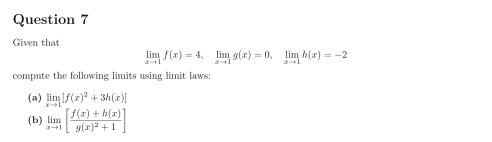
Given that limx→1f(x)=4,limx→1g(x)=0,limx→1h(x)=−2\lim_{x \to 1} f(x) = 4, \quad \lim_{x \to 1} g(x) = 0, \quad \lim_{x \to 1} h(x) = -2 compute the following limits using limit laws:

(a) lim⁡x→1[f(x)2+3h(x)]\displaystyle \lim_{x \to 1} [f(x)^2 + 3h(x)]

(b) lim⁡x→1[f(x)+h(x)g(x)2+1]\displaystyle \lim_{x \to 1} \left[ \frac{f(x) + h(x)}{g(x)^2 + 1} \right]

Original worksheet page 1: question and worked solution for 2-4-007
Show solutionHide solution

Question 7 - Solution

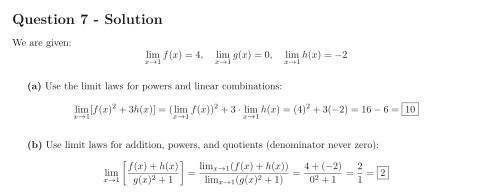
We are given: limx→1f(x)=4,limx→1g(x)=0,limx→1h(x)=−2\lim_{x \to 1} f(x) = 4, \quad \lim_{x \to 1} g(x) = 0, \quad \lim_{x \to 1} h(x) = -2

(a) Use the limit laws for powers and linear combinations: limx→1[f(x)2+3h(x)]=(limx→1f(x))2+3⋅limx→1h(x)=(4)2+3(−2)=16−6=10\lim_{x \to 1} [f(x)^2 + 3h(x)] = (\lim_{x \to 1} f(x))^2 + 3 \cdot \lim_{x \to 1} h(x) = (4)^2 + 3(-2) = 16 - 6 = \boxed{10}

(b) Use limit laws for addition, powers, and quotients (denominator never zero): limx→1[f(x)+h(x)g(x)2+1]=limx→1(f(x)+h(x))limx→1(g(x)2+1)=4+(−2)02+1=21=2\lim_{x \to 1} \left[ \frac{f(x) + h(x)}{g(x)^2 + 1} \right] = \frac{\lim_{x \to 1} (f(x) + h(x))}{\lim_{x \to 1} (g(x)^2 + 1)} = \frac{4 + (-2)}{0^2 + 1} = \frac{2}{1} = \boxed{2}

Original worksheet page 2: question and worked solution for 2-4-007

Original worksheet layout. Use Enlarge or open the PDF for a closer view.