Infinite Limits — Question 2

PDF ↗

Question 2

Evaluate the limit: limx→0+tan⁡xx.\lim_{x \to 0^+} \frac{\tan x}{x}.

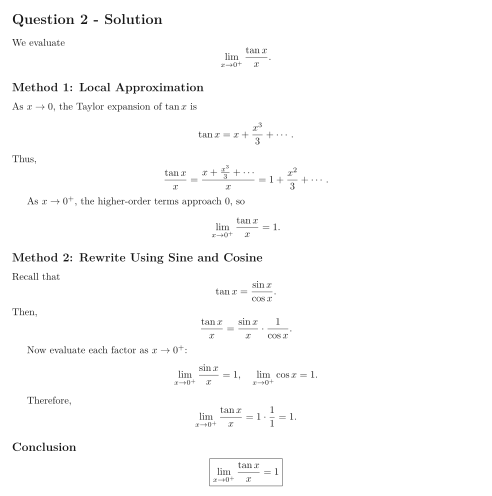
Original worksheet page 1: question and worked solution for 2-6-002
Show solutionHide solution

Question 2 - Solution

We evaluate limx→0+tan⁡xx.\lim_{x \to 0^+} \frac{\tan x}{x}.

Method 1: Local Approximation

As x→0x \to 0, the Taylor expansion of tan⁡x\tan x is tan⁡x=x+x33+⋯.\tan x = x + \frac{x^3}{3} + \cdots. Thus, tan⁡xx=x+x33+⋯x=1+x23+⋯.\frac{\tan x}{x} = \frac{x + \frac{x^3}{3} + \cdots}{x} = 1 + \frac{x^2}{3} + \cdots.

As x→0+x \to 0^+, the higher-order terms approach 0, so limx→0+tan⁡xx=1.\lim_{x \to 0^+} \frac{\tan x}{x} = 1.

Method 2: Rewrite Using Sine and Cosine

Recall that tan⁡x=sin⁡xcos⁡x.\tan x = \frac{\sin x}{\cos x}. Then, tan⁡xx=sin⁡xx⋅1cos⁡x.\frac{\tan x}{x} = \frac{\sin x}{x} \cdot \frac{1}{\cos x}.

Now evaluate each factor as x→0+x \to 0^+: limx→0+sin⁡xx=1,limx→0+cos⁡x=1.\lim_{x \to 0^+} \frac{\sin x}{x} = 1, \quad \lim_{x \to 0^+} \cos x = 1.

Therefore, limx→0+tan⁡xx=1⋅11=1.\lim_{x \to 0^+} \frac{\tan x}{x} = 1 \cdot \frac{1}{1} = 1.

Conclusion

limx→0+tan⁡xx=1\boxed{\lim_{x \to 0^+} \frac{\tan x}{x} = 1}

Original worksheet page 2: question and worked solution for 2-6-002

Original worksheet layout. Use Enlarge or open the PDF for a closer view.