The Definition of the Derivative — Question 2

PDF ↗

Question 2

Let f(x)=4x+1f(x) = \sqrt{4x + 1}

Use the definition of the derivative to compute f′(2)f'(2). Show all steps clearly without using shortcut rules.

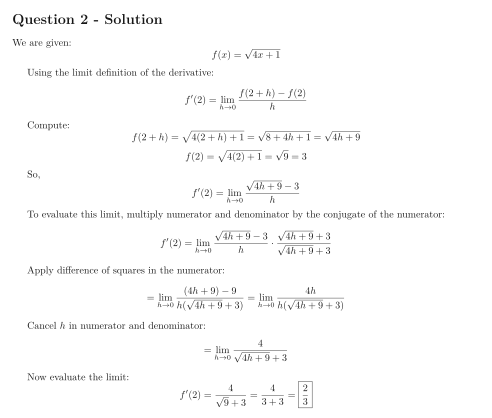
Original worksheet page 1: question and worked solution for 3-1-002
Show solutionHide solution

Question 2 - Solution

We are given: f(x)=4x+1f(x) = \sqrt{4x + 1}

Using the limit definition of the derivative: f′(2)=limh→0f(2+h)−f(2)hf'(2) = \lim_{h \to 0} \frac{f(2 + h) - f(2)}{h}

Compute: f(2+h)=4(2+h)+1=8+4h+1=4h+9f(2 + h) = \sqrt{4(2 + h) + 1} = \sqrt{8 + 4h + 1} = \sqrt{4h + 9} f(2)=4(2)+1=9=3f(2) = \sqrt{4(2) + 1} = \sqrt{9} = 3

So, f′(2)=limh→04h+9−3hf'(2) = \lim_{h \to 0} \frac{\sqrt{4h + 9} - 3}{h}

To evaluate this limit, multiply numerator and denominator by the conjugate of the numerator: f′(2)=limh→04h+9−3h⋅4h+9+34h+9+3f'(2) = \lim_{h \to 0} \frac{\sqrt{4h + 9} - 3}{h} \cdot \frac{\sqrt{4h + 9} + 3}{\sqrt{4h + 9} + 3}

Apply difference of squares in the numerator: =limh→0(4h+9)−9h(4h+9+3)=limh→04hh(4h+9+3)= \lim_{h \to 0} \frac{(4h + 9) - 9}{h(\sqrt{4h + 9} + 3)} = \lim_{h \to 0} \frac{4h}{h(\sqrt{4h + 9} + 3)}

Cancel hh in numerator and denominator: =limh→044h+9+3= \lim_{h \to 0} \frac{4}{\sqrt{4h + 9} + 3}

Now evaluate the limit: f′(2)=49+3=43+3=23f'(2) = \frac{4}{\sqrt{9} + 3} = \frac{4}{3 + 3} = \boxed{\frac{2}{3}}

Original worksheet page 2: question and worked solution for 3-1-002

Original worksheet layout. Use Enlarge or open the PDF for a closer view.