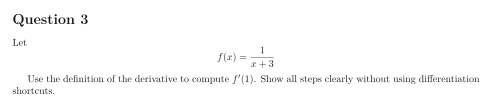
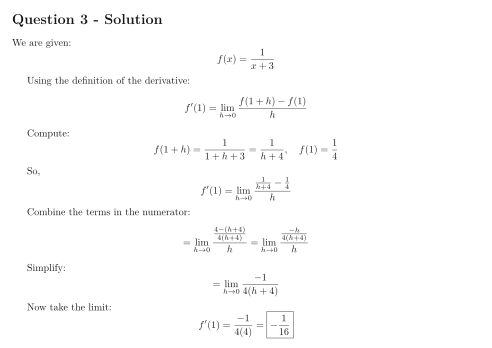
Question 3 Let f(x)=1x+3f(x) = \frac{1}{x + 3} Use the definition of the derivative to compute f′(1)f'(1). Show all steps clearly without using differentiation shortcuts. Show solutionHide solution+Question 3 - Solution We are given: f(x)=1x+3f(x) = \frac{1}{x + 3} Using the definition of the derivative: f′(1)=limh→0f(1+h)−f(1)hf'(1) = \lim_{h \to 0} \frac{f(1 + h) - f(1)}{h} Compute: f(1+h)=11+h+3=1h+4,f(1)=14f(1 + h) = \frac{1}{1 + h + 3} = \frac{1}{h + 4}, \quad f(1) = \frac{1}{4} So, f′(1)=limh→01h+4−14hf'(1) = \lim_{h \to 0} \frac{\frac{1}{h + 4} - \frac{1}{4}}{h} Combine the terms in the numerator: =limh→04−(h+4)4(h+4)h=limh→0−h4(h+4)h= \lim_{h \to 0} \frac{\frac{4 - (h + 4)}{4(h + 4)}}{h} = \lim_{h \to 0} \frac{\frac{-h}{4(h + 4)}}{h} Simplify: =limh→0−14(h+4)= \lim_{h \to 0} \frac{-1}{4(h + 4)} Now take the limit: f′(1)=−14(4)=−116f'(1) = \frac{-1}{4(4)} = \boxed{-\frac{1}{16}}