Question 10
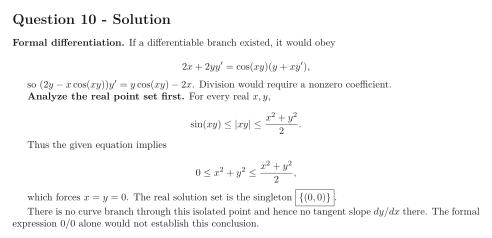
Consider the real relation
(a) Derive the formal relation obtained by implicit differentiation. State when division would be valid.
(b) Determine the real solution set and decide whether a tangent slope exists at .
Show solutionHide solution
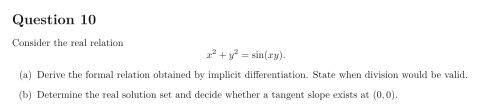
Question 10 - Solution
Formal differentiation. If a differentiable branch existed, it would obey
so . Division would require a nonzero coefficient.
Analyze the real point set first. For every real ,
Thus the given equation implies
which forces . The real solution set is the singleton .
There is no curve branch through this isolated point and hence no tangent slope there. The formal expression alone would not establish this conclusion.