Question 3
Problem:
A spherical balloon is being inflated such that its radius increases at a constant rate of cm/min.
(a) At what rate is the volume of the balloon increasing when the radius is 10 cm?
(b) Include units and interpret the meaning of your result.
See the diagram in the original worksheet below.

Show solutionHide solution
Question 3 - Solution
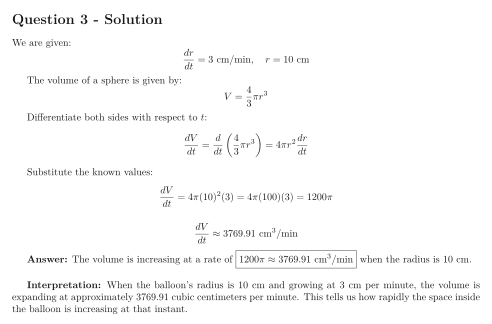
We are given:
The volume of a sphere is given by:
Differentiate both sides with respect to :
Substitute the known values:
Answer: The volume is increasing at a rate of when the radius is 10 cm.
Interpretation: When the balloon’s radius is 10 cm and growing at 3 cm per minute, the volume is expanding at approximately 3769.91 cubic centimeters per minute. This tells us how rapidly the space inside the balloon is increasing at that instant.