Related Rates — Question 7

PDF ↗

Question 7

The minute hand of a clock completes one full revolution every 60 minutes, and the hour hand completes one full revolution every 12 hours.

Question: At exactly 3:00, how fast is the smaller angle between the hour and minute hands changing?

See the diagram in the original worksheet below.
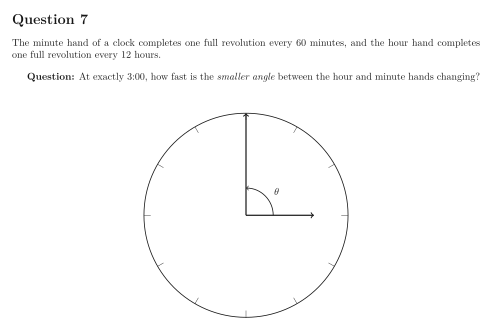
Original worksheet page 1: question and worked solution for 3-11-007
Show solutionHide solution

Let θ(t)\theta(t) be the signed angle (in degrees) from the hour hand to the minute hand.

ωm=360/60=6∘/min,ωh=360/(12*60)=0.5∘/min\omega_m = 360/60 = 6^\circ/\text{min}, \quad \omega_h = 360/(12*60) = 0.5^\circ/\text{min}

At 3:00, the hour hand is at 90∘90^\circ and the minute hand is at 0∘0^\circ.

θ(t)=(6t)−(90+0.5t)\theta(t) = (6t) - (90 + 0.5t)

Differentiate: dθdt=6−0.5=5.5\frac{d\theta}{dt} = 6 - 0.5 = 5.5

Since the smaller angle is initially decreasing, dθdt=−5.5∘/min\boxed{\frac{d\theta}{dt} = -5.5^\circ/\text{min}}

Question 7 - Solution)

The angle between the hands changes at the difference of their angular speeds.

Minute hand speed=6∘/min\text{Minute hand speed} = 6^\circ/\text{min} Hour hand speed=0.5∘/min\text{Hour hand speed} = 0.5^\circ/\text{min}

So the angle closes at: 6−0.5=5.5∘/min6 - 0.5 = 5.5^\circ/\text{min}

Since the hands are moving toward each other at 3:00, the angle is decreasing.

5.5∘/min (decreasing)\boxed{5.5^\circ/\text{min (decreasing)}}

Final Answer

dθdt=−5.5∘/min\boxed{\frac{d\theta}{dt} = -5.5^\circ/\text{min}}

The negative sign indicates the angle between the hands is decreasing.
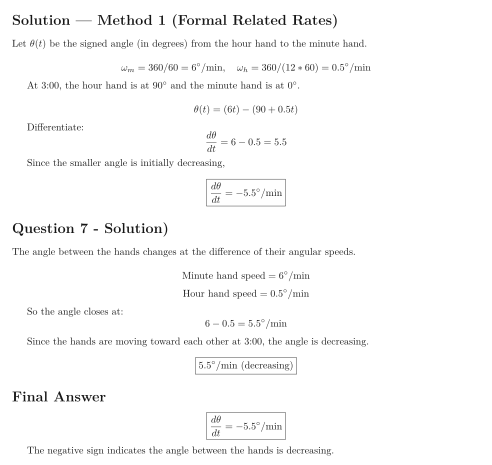
Original worksheet page 2: question and worked solution for 3-11-007

Original worksheet layout. Use Enlarge or open the PDF for a closer view.