Related Rates — Question 9

PDF ↗

Question 9

A 10-meter-long beam is leaning against a vertical wall and a horizontal floor, forming a right triangle. The bottom of the beam is sliding away from the wall along the floor at a rate of 1.5 m/s.

How fast is the top of the beam sliding down the wall when the bottom is 6 meters away from the wall?

See the diagram in the original worksheet below.
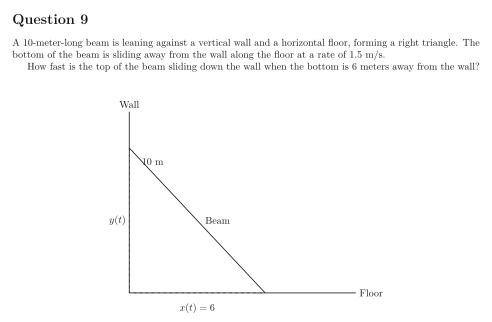
Original worksheet page 1: question and worked solution for 3-11-009
Show solutionHide solution

Question 9 - Solution

Let:

x(t)x(t): distance from the base of the wall to the bottom of the beam

y(t)y(t): height of the beam on the wall

The beam is 10 m long ⇒x2+y2=100\Rightarrow x^2 + y^2 = 100

Differentiate both sides with respect to time: 2xdxdt+2ydydt=0⇒xdxdt+ydydt=02x \frac{dx}{dt} + 2y \frac{dy}{dt} = 0 \Rightarrow x \frac{dx}{dt} + y \frac{dy}{dt} = 0

Given: x=6x = 6, dxdt=1.5\frac{dx}{dt} = 1.5

Find yy from Pythagoras: y=100−62=64=8y = \sqrt{100 - 6^2} = \sqrt{64} = 8

Now solve for dydt\frac{dy}{dt}: 6(1.5)+8dydt=0⇒9+8dydt=0⇒dydt=−986(1.5) + 8 \frac{dy}{dt} = 0 \Rightarrow 9 + 8 \frac{dy}{dt} = 0 \Rightarrow \frac{dy}{dt} = -\frac{9}{8}

Conclusion: The top of the beam is sliding down at a rate of: dydt=−98=−1.125 m/s\boxed{\frac{dy}{dt} = -\frac{9}{8} = -1.125 \text{ m/s}}
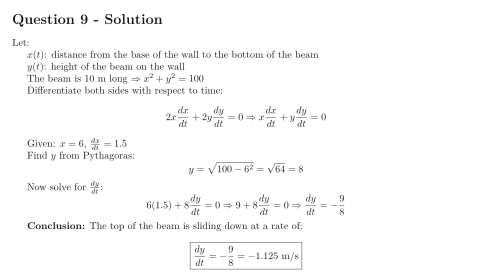
Original worksheet page 2: question and worked solution for 3-11-009

Original worksheet layout. Use Enlarge or open the PDF for a closer view.