Higher Order Derivatives — Question 7

PDF ↗

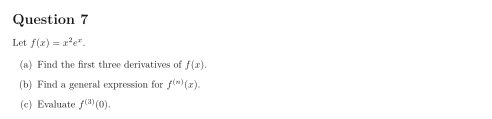
Question 7

Let f(x)=x2exf(x) = x^2 e^x.

  • (a) Find the first three derivatives of f(x)f(x).

  • (b) Find a general expression for f(n)(x)f^{(n)}(x).

  • (c) Evaluate f(3)(0)f^{(3)}(0).

Original worksheet page 1: question and worked solution for 3-12-007
Show solutionHide solution

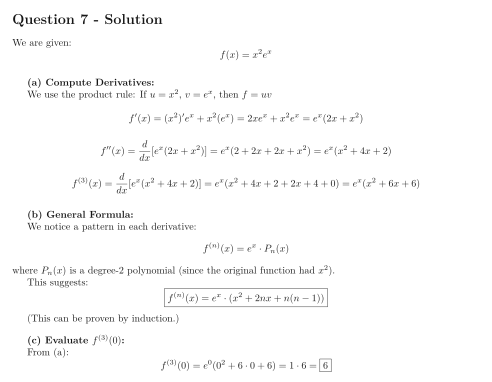
Question 7 - Solution

We are given: f(x)=x2exf(x) = x^2 e^x

(a) Compute Derivatives:

We use the product rule: If u=x2u = x^2, v=exv = e^x, then f=uvf = uv

f′(x)=(x2)′ex+x2(ex)=2xex+x2ex=ex(2x+x2)f'(x) = (x^2)' e^x + x^2 (e^x) = 2x e^x + x^2 e^x = e^x(2x + x^2)

f″(x)=ddx[ex(2x+x2)]=ex(2+2x+2x+x2)=ex(x2+4x+2)f''(x) = \frac{d}{dx}[e^x(2x + x^2)] = e^x(2 + 2x + 2x + x^2) = e^x(x^2 + 4x + 2)

f(3)(x)=ddx[ex(x2+4x+2)]=ex(x2+4x+2+2x+4+0)=ex(x2+6x+6)f^{(3)}(x) = \frac{d}{dx}[e^x(x^2 + 4x + 2)] = e^x(x^2 + 4x + 2 + 2x + 4 + 0) = e^x(x^2 + 6x + 6)

(b) General Formula:

We notice a pattern in each derivative: f(n)(x)=ex⋅Pn(x)f^{(n)}(x) = e^x \cdot P_n(x) where Pn(x)P_n(x) is a degree-2 polynomial (since the original function had x2x^2).

This suggests: f(n)(x)=ex⋅(x2+2nx+n(n−1))\boxed{f^{(n)}(x) = e^x \cdot (x^2 + 2nx + n(n - 1))}

(This can be proven by induction.)

(c) Evaluate f(3)(0)f^{(3)}(0):

From (a): f(3)(0)=e0(02+6⋅0+6)=1⋅6=6f^{(3)}(0) = e^0(0^2 + 6 \cdot 0 + 6) = 1 \cdot 6 = \boxed{6}

Original worksheet page 2: question and worked solution for 3-12-007

Original worksheet layout. Use Enlarge or open the PDF for a closer view.