Logarithmic Differentiation — Question 4

PDF ↗

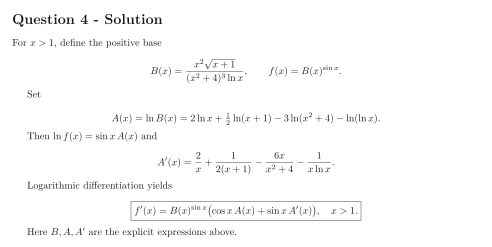
Question 4

For x>1x>1 (so the base is positive), let the function be: f(x)=(x2⋅x+1(x2+4)3⋅ln⁡x)sin⁡xf(x) = \left( \frac{x^2 \cdot \sqrt{x + 1}}{(x^2 + 4)^3 \cdot \ln x} \right)^{\sin x}

  • (a) Use logarithmic differentiation to find f′(x)f'(x).

  • (b) Simplify your answer as much as possible.
Original worksheet page 1: question and worked solution for 3-13-004
Show solutionHide solution

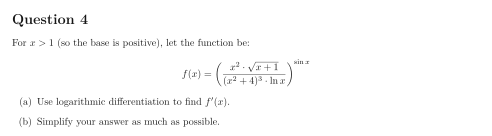
Question 4 - Solution

For x>1x>1, define the positive base

B(x)=x2x+1(x2+4)3ln⁡x,f(x)=B(x)sin⁡x.B(x)=\frac{x^2\sqrt{x+1}}{(x^2+4)^3\ln x},\qquad f(x)=B(x)^{\sin x}.

Set

A(x)=ln⁡B(x)=2ln⁡x+12ln⁡(x+1)−3ln⁡(x2+4)−ln⁡(ln⁡x).A(x)=\ln B(x)=2\ln x+\tfrac12\ln(x+1)-3\ln(x^2+4)-\ln(\ln x).

Then ln⁡f(x)=sin⁡xA(x)\ln f(x)=\sin x\,A(x) and

A′(x)=2x+12(x+1)−6xx2+4−1xln⁡x.A'(x)=\frac2x+\frac1{2(x+1)}-\frac{6x}{x^2+4}-\frac1{x\ln x}.

Logarithmic differentiation yields

f′(x)=B(x)sin⁡x(cos⁡xA(x)+sin⁡xA′(x)),x>1.\boxed{f'(x)=B(x)^{\sin x}\bigl(\cos x\,A(x)+\sin x\,A'(x)\bigr),\quad x>1.}

Here B,A,A′B,A,A' are the explicit expressions above.

Original worksheet page 2: question and worked solution for 3-13-004

Original worksheet layout. Use Enlarge or open the PDF for a closer view.