Logarithmic Differentiation — Question 8

PDF ↗

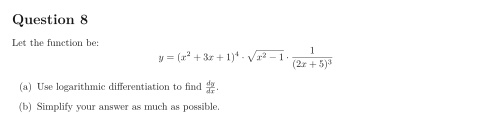
Question 8

Let the function be: y=(x2+3x+1)4⋅x2−1⋅1(2x+5)3y = (x^2 + 3x + 1)^4 \cdot \sqrt{x^2 - 1} \cdot \frac{1}{(2x + 5)^3}

  • (a) Use logarithmic differentiation to find dydx\frac{dy}{dx}.

  • (b) Simplify your answer as much as possible.
Original worksheet page 1: question and worked solution for 3-13-008
Show solutionHide solution

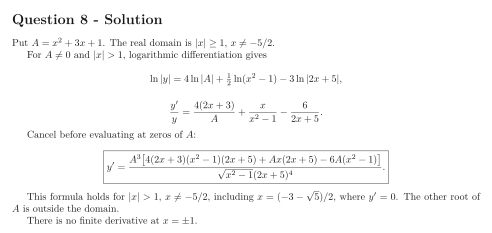
Question 8 - Solution

Put A=x2+3x+1A=x^2+3x+1. The real domain is |x|≥1|x|\geq1, x≠−5/2x\ne-5/2.

For A≠0A\ne0 and |x|>1|x|>1, logarithmic differentiation gives

ln⁡|y|=4ln⁡|A|+12ln⁡(x2−1)−3ln⁡|2x+5|,\ln|y|=4\ln|A|+\tfrac12\ln(x^2-1)-3\ln|2x+5|,

y′y=4(2x+3)A+xx2−1−62x+5.\frac{y'}y=\frac{4(2x+3)}A+\frac{x}{x^2-1}-\frac6{2x+5}.

Cancel before evaluating at zeros of AA:

y′=A3[4(2x+3)(x2−1)(2x+5)+Ax(2x+5)−6A(x2−1)]x2−1(2x+5)4.\boxed{y'=\frac{A^3\big[4(2x+3)(x^2-1)(2x+5)+Ax(2x+5)-6A(x^2-1)\big]}{\sqrt{x^2-1}(2x+5)^4}.}

This formula holds for |x|>1|x|>1, x≠−5/2x\ne-5/2, including x=(−3−5)/2x=(-3-\sqrt5)/2, where y′=0y'=0. The other root of AA is outside the domain.

There is no finite derivative at x=±1x=\pm1.

Original worksheet page 2: question and worked solution for 3-13-008

Original worksheet layout. Use Enlarge or open the PDF for a closer view.