Logarithmic Differentiation — Question 10

PDF ↗

Question 10

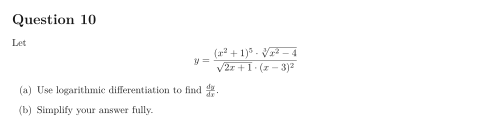
Let y=(x2+1)5⋅x2−432x+1⋅(x−3)2y = \frac{(x^2 + 1)^5 \cdot \sqrt[3]{x^2 - 4}}{\sqrt{2x + 1} \cdot (x - 3)^2}

  • (a) Use logarithmic differentiation to find dydx\frac{dy}{dx}.

  • (b) Simplify your answer fully.

Original worksheet page 1: question and worked solution for 3-13-010
Show solutionHide solution

Question 10 - Solution

The real domain is x>−12,x≠3x>-\tfrac12,\ x\ne3. Where the function is nonzero, use absolute values in logarithmic differentiation:

ln⁡|y|=5ln⁡(x2+1)+13ln⁡|x2−4|−12ln⁡(2x+1)−2ln⁡|x−3|\ln|y|=5\ln(x^2+1)+\tfrac13\ln|x^2-4|-\tfrac12\ln(2x+1)-2\ln|x-3|

Differentiating gives

y′=y(10xx2+1+2x3(x2−4)−12x+1−2x−3).\boxed{y'=y\left(\frac{10x}{x^2+1}+\frac{2x}{3(x^2-4)}-\frac1{2x+1}-\frac2{x-3}\right).}

This formula holds for x>−12,x≠2,3x>-\tfrac12,\ x\ne2,3. At x=2x=2, y=0y=0, but there is no finite derivative because of the cube-root factor.
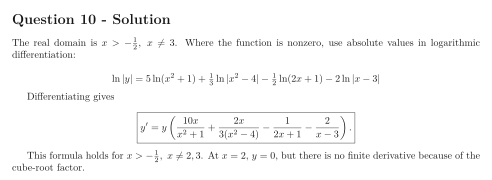
Original worksheet page 2: question and worked solution for 3-13-010

Original worksheet layout. Use Enlarge or open the PDF for a closer view.