Interpretation of the Derivative — Question 2

PDF ↗

Question 2

A rock is thrown vertically upward from the top of a cliff. Its height in meters after tt seconds is given by: h(t)=−5t2+20t+50h(t) = -5t^2 + 20t + 50

  • (a) What is the velocity of the rock after 2 seconds?

  • (b) When does the rock reach its maximum height?

  • (c) When does the rock hit the ground?

  • (d) What is the velocity of the rock at the moment it hits the ground?
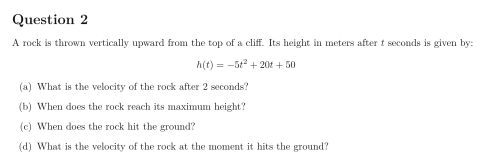
Original worksheet page 1: question and worked solution for 3-2-002
Show solutionHide solution

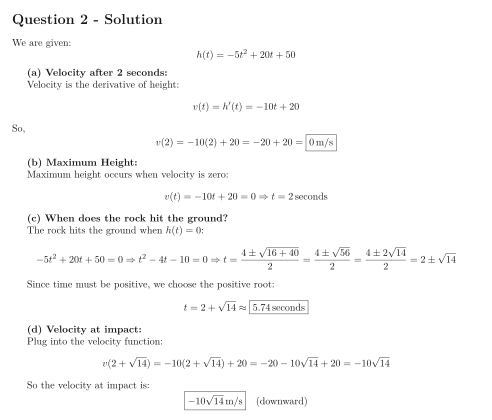
Question 2 - Solution

We are given: h(t)=−5t2+20t+50h(t) = -5t^2 + 20t + 50

(a) Velocity after 2 seconds:

Velocity is the derivative of height: v(t)=h′(t)=−10t+20v(t) = h'(t) = -10t + 20 So, v(2)=−10(2)+20=−20+20=0m/sv(2) = -10(2) + 20 = -20 + 20 = \boxed{0 \, \text{m/s}}

(b) Maximum Height:

Maximum height occurs when velocity is zero: v(t)=−10t+20=0⇒t=2secondsv(t) = -10t + 20 = 0 \Rightarrow t = 2 \, \text{seconds}

(c) When does the rock hit the ground?

The rock hits the ground when h(t)=0h(t) = 0: −5t2+20t+50=0⇒t2−4t−10=0⇒t=4±16+402=4±562=4±2142=2±14-5t^2 + 20t + 50 = 0 \Rightarrow t^2 - 4t - 10 = 0 \Rightarrow t = \frac{4 \pm \sqrt{16 + 40}}{2} = \frac{4 \pm \sqrt{56}}{2} = \frac{4 \pm 2\sqrt{14}}{2} = 2 \pm \sqrt{14}

Since time must be positive, we choose the positive root: t=2+14≈5.74secondst = 2 + \sqrt{14} \approx \boxed{5.74 \, \text{seconds}}

(d) Velocity at impact:

Plug into the velocity function: v(2+14)=−10(2+14)+20=−20−1014+20=−1014v(2 + \sqrt{14}) = -10(2 + \sqrt{14}) + 20 = -20 - 10\sqrt{14} + 20 = -10\sqrt{14}

So the velocity at impact is: −1014m/s(downward)\boxed{-10\sqrt{14} \, \text{m/s}} \quad \text{(downward)}

Original worksheet page 2: question and worked solution for 3-2-002

Original worksheet layout. Use Enlarge or open the PDF for a closer view.