Question 5
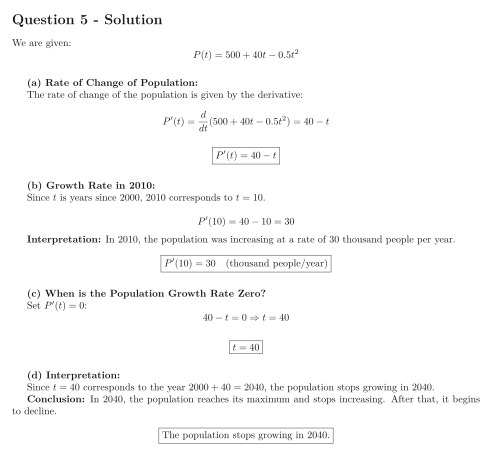
The population of a certain city (in thousands) , as a function of time (in years since 2000), is modeled by the function:
(a) Find the rate of change of the population with respect to time.
(b) What is the population growth rate in the year 2010?
(c) At what year is the population growth rate zero?
(d) Interpret your result from (c) in the context of the population.
Show solutionHide solution
Question 5 - Solution
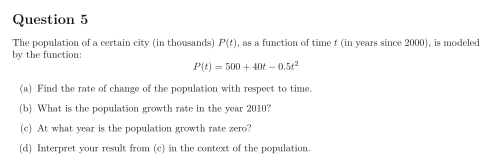
We are given:
(a) Rate of Change of Population:
The rate of change of the population is given by the derivative:
(b) Growth Rate in 2010:
Since is years since 2000, 2010 corresponds to .
Interpretation: In 2010, the population was increasing at a rate of 30 thousand people per year.
(c) When is the Population Growth Rate Zero?
Set :
(d) Interpretation:
Since corresponds to the year , the population stops growing in 2040.
Conclusion: In 2040, the population reaches its maximum and stops increasing. After that, it begins to decline.