Question 7
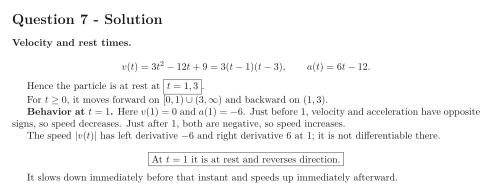
The position of a particle moving along a straight line is given by the function where is in meters and is in seconds.
(a) Find the velocity function .
(b) At what time(s) is the particle at rest?
(c) Determine the direction of motion (moving forward or backward) on the intervals determined by part (b).
(d) Is the particle speeding up or slowing down at ? Justify using acceleration.
Show solutionHide solution
Question 7 - Solution
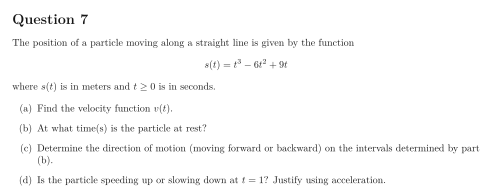
Velocity and rest times.
Hence the particle is at rest at .
For , it moves forward on and backward on .
Behavior at . Here and . Just before , velocity and acceleration have opposite signs, so speed decreases. Just after , both are negative, so speed increases.
The speed has left derivative and right derivative at ; it is not differentiable there.
It slows down immediately before that instant and speeds up immediately afterward.