Interpretation of the Derivative — Question 9

PDF ↗

Question 9

The position s(t)s(t) of a particle moving along a straight line is given by: s(t)=3t2+2t+1,t>0s(t) = \frac{3t^2 + 2}{t + 1}, \quad t > 0

  • (a) Find the instantaneous velocity of the particle at t=1t = 1.

  • (b) Interpret the sign of the velocity at t=1t = 1.

  • (c) Find all critical points of s(t)s(t) and determine whether the particle changes direction.
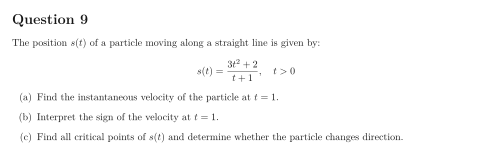
Original worksheet page 1: question and worked solution for 3-2-009
Show solutionHide solution

Question 9 - Solution

We are given: s(t)=3t2+2t+1,t>0s(t) = \frac{3t^2 + 2}{t + 1}, \quad t > 0

(a) Instantaneous Velocity at t=1t = 1:

Velocity is the derivative s′(t)s'(t). Using the quotient rule:

s′(t)=(t+1)(6t)−(3t2+2)(1)(t+1)2s'(t) = \frac{(t+1)(6t) - (3t^2 + 2)(1)}{(t+1)^2}

=6t2+6t−3t2−2(t+1)2=3t2+6t−2(t+1)2= \frac{6t^2 + 6t - 3t^2 - 2}{(t+1)^2} = \frac{3t^2 + 6t - 2}{(t+1)^2}

Evaluate at t=1t = 1: s′(1)=3+6−24=74s'(1) = \frac{3 + 6 - 2}{4} = \frac{7}{4}

s′(1)=74\boxed{s'(1) = \frac{7}{4}}

(b) Interpretation of the Sign of Velocity:

Since s′(1)=74>0s'(1) = \frac{7}{4} > 0, the particle is moving in the positive direction at t=1t = 1.

The particle is moving to the right (increasing position) at t=1\boxed{\text{The particle is moving to the right (increasing position) at } t = 1}

(c) Critical Points and Direction Change:

Critical points occur where s′(t)=0s'(t) = 0 or where s′(t)s'(t) is undefined.

The derivative is undefined at t=−1t = -1, which is outside the domain t>0t > 0 and therefore ignored.

Set the numerator equal to zero: 3t2+6t−2=03t^2 + 6t - 2 = 0

t=−6±36+246=−6±606=−3±153t = \frac{-6 \pm \sqrt{36 + 24}}{6} = \frac{-6 \pm \sqrt{60}}{6} = \frac{-3 \pm \sqrt{15}}{3}

This gives two solutions: t=−3−153andt=−3+153t = \frac{-3 - \sqrt{15}}{3} \quad \text{and} \quad t = \frac{-3 + \sqrt{15}}{3}

Since time must satisfy t>0t > 0, the negative solution is rejected. The only valid critical time is: t=−3+153\boxed{t = \frac{-3 + \sqrt{15}}{3}}

To determine whether the particle changes direction, test the sign of s′(t)s'(t) on either side of this value (within t>0t > 0). The derivative changes from negative to positive, indicating a direction change.
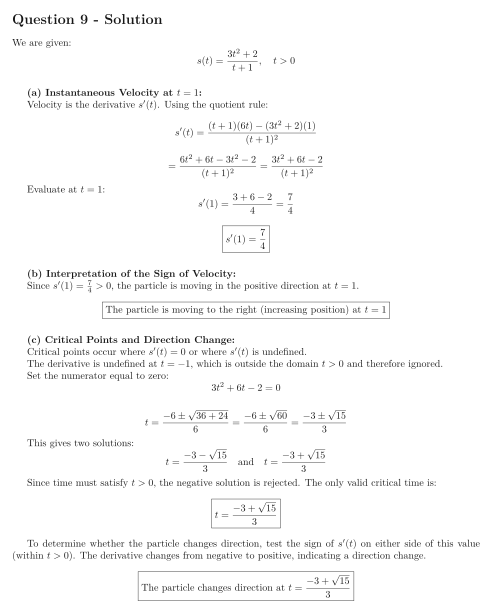
The particle changes direction at t=−3+153\boxed{\text{The particle changes direction at } t = \frac{-3 + \sqrt{15}}{3}}

Original worksheet page 2: question and worked solution for 3-2-009

Original worksheet layout. Use Enlarge or open the PDF for a closer view.