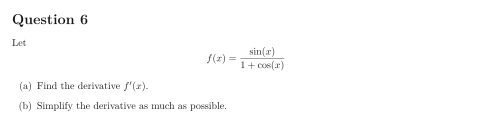
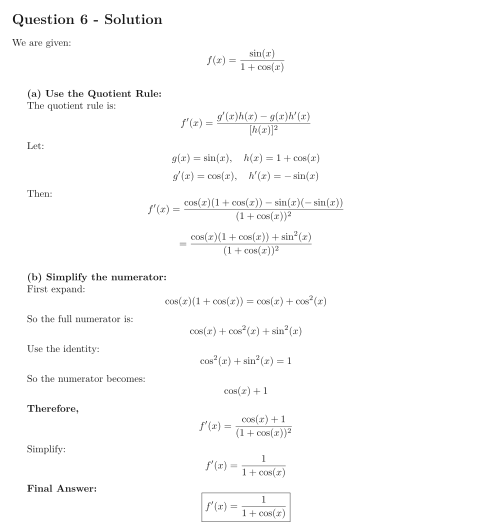
Question 6 Let f(x)=sin(x)1+cos(x)f(x) = \frac{\sin(x)}{1 + \cos(x)} (a) Find the derivative f′(x)f'(x). (b) Simplify the derivative as much as possible. Show solutionHide solution+Question 6 - Solution We are given: f(x)=sin(x)1+cos(x)f(x) = \frac{\sin(x)}{1 + \cos(x)} (a) Use the Quotient Rule: The quotient rule is: f′(x)=g′(x)h(x)−g(x)h′(x)[h(x)]2f'(x) = \frac{g'(x)h(x) - g(x)h'(x)}{[h(x)]^2} Let: g(x)=sin(x),h(x)=1+cos(x)g(x) = \sin(x), \quad h(x) = 1 + \cos(x) g′(x)=cos(x),h′(x)=−sin(x)g'(x) = \cos(x), \quad h'(x) = -\sin(x) Then: f′(x)=cos(x)(1+cos(x))−sin(x)(−sin(x))(1+cos(x))2f'(x) = \frac{\cos(x)(1 + \cos(x)) - \sin(x)(- \sin(x))}{(1 + \cos(x))^2} =cos(x)(1+cos(x))+sin2(x)(1+cos(x))2= \frac{\cos(x)(1 + \cos(x)) + \sin^2(x)}{(1 + \cos(x))^2} (b) Simplify the numerator: First expand: cos(x)(1+cos(x))=cos(x)+cos2(x)\cos(x)(1 + \cos(x)) = \cos(x) + \cos^2(x) So the full numerator is: cos(x)+cos2(x)+sin2(x)\cos(x) + \cos^2(x) + \sin^2(x) Use the identity: cos2(x)+sin2(x)=1\cos^2(x) + \sin^2(x) = 1 So the numerator becomes: cos(x)+1\cos(x) + 1 Therefore, f′(x)=cos(x)+1(1+cos(x))2f'(x) = \frac{\cos(x) + 1}{(1 + \cos(x))^2} Simplify: f′(x)=11+cos(x)f'(x) = \frac{1}{1 + \cos(x)} Final Answer: f′(x)=11+cos(x)\boxed{f'(x) = \frac{1}{1 + \cos(x)}}