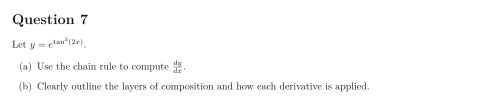
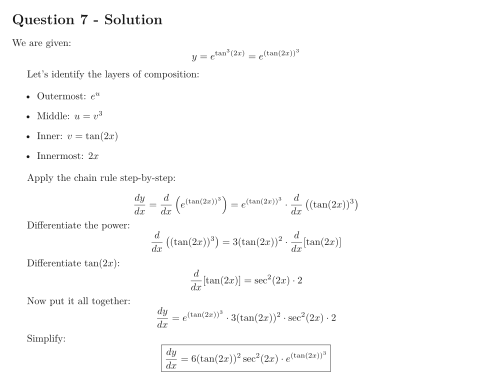
Question 7 Let y=etan3(2x)y = e^{\tan^3(2x)}. (a) Use the chain rule to compute dydx\frac{dy}{dx}. (b) Clearly outline the layers of composition and how each derivative is applied. Show solutionHide solution+Question 7 - Solution We are given: y=etan3(2x)=e(tan(2x))3y = e^{\tan^3(2x)} = e^{(\tan(2x))^3} Let’s identify the layers of composition: Outermost: eue^u Middle: u=v3u = v^3 Inner: v=tan(2x)v = \tan(2x) Innermost: 2x2x Apply the chain rule step-by-step: dydx=ddx(e(tan(2x))3)=e(tan(2x))3⋅ddx((tan(2x))3)\frac{dy}{dx} = \frac{d}{dx} \left( e^{(\tan(2x))^3} \right) = e^{(\tan(2x))^3} \cdot \frac{d}{dx} \left( (\tan(2x))^3 \right) Differentiate the power: ddx((tan(2x))3)=3(tan(2x))2⋅ddx[tan(2x)]\frac{d}{dx} \left( (\tan(2x))^3 \right) = 3(\tan(2x))^2 \cdot \frac{d}{dx}[\tan(2x)] Differentiate tan(2x)\tan(2x): ddx[tan(2x)]=sec2(2x)⋅2\frac{d}{dx}[\tan(2x)] = \sec^2(2x) \cdot 2 Now put it all together: dydx=e(tan(2x))3⋅3(tan(2x))2⋅sec2(2x)⋅2\frac{dy}{dx} = e^{(\tan(2x))^3} \cdot 3(\tan(2x))^2 \cdot \sec^2(2x) \cdot 2 Simplify: dydx=6(tan(2x))2sec2(2x)⋅e(tan(2x))3\boxed{ \frac{dy}{dx} = 6(\tan(2x))^2 \sec^2(2x) \cdot e^{(\tan(2x))^3} }