L’Hospital’s Rule and Indeterminate Forms — Question 3

PDF ↗

Question 3

Evaluate the limit: limx→∞(xln(1+1x))\lim_{x \to \infty} \left( x \ln\left(1 + \frac{1}{x} \right) \right)

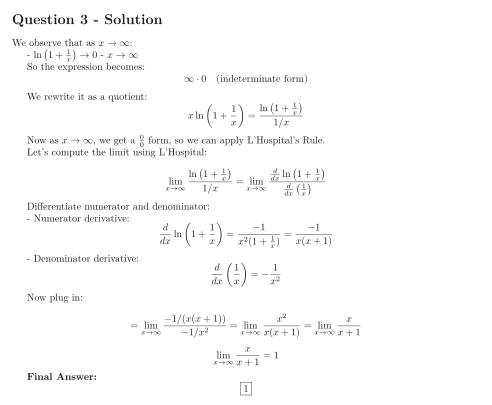
Original worksheet page 1: question and worked solution for 4-10-003
Show solutionHide solution

Question 3 - Solution

We observe that as x→∞x \to \infty:

- ln⁡(1+1x)→0\ln\left(1 + \frac{1}{x} \right) \to 0 - x→∞x \to \infty

So the expression becomes: ∞⋅0(indeterminate form)\infty \cdot 0 \quad \text{(indeterminate form)}

We rewrite it as a quotient: xln⁡(1+1x)=ln⁡(1+1x)1/xx \ln\left(1 + \frac{1}{x} \right) = \frac{\ln\left(1 + \frac{1}{x} \right)}{1/x}

Now as x→∞x \to \infty, we get a 00\frac{0}{0} form, so we can apply L’Hospital’s Rule.

Let’s compute the limit using L’Hospital:

limx→∞ln⁡(1+1x)1/x=limx→∞ddxln⁡(1+1x)ddx(1x)\lim_{x \to \infty} \frac{\ln\left(1 + \frac{1}{x} \right)}{1/x} = \lim_{x \to \infty} \frac{\frac{d}{dx} \ln\left(1 + \frac{1}{x} \right)}{\frac{d}{dx} \left( \frac{1}{x} \right)}

Differentiate numerator and denominator:

- Numerator derivative: ddxln⁡(1+1x)=−1x2(1+1x)=−1x(x+1)\frac{d}{dx} \ln\left(1 + \frac{1}{x} \right) = \frac{-1}{x^2 (1 + \frac{1}{x})} = \frac{-1}{x(x+1)}

- Denominator derivative: ddx(1x)=−1x2\frac{d}{dx} \left( \frac{1}{x} \right) = -\frac{1}{x^2}

Now plug in:

=limx→∞−1/(x(x+1))−1/x2=limx→∞x2x(x+1)=limx→∞xx+1= \lim_{x \to \infty} \frac{-1/(x(x+1))}{-1/x^2} = \lim_{x \to \infty} \frac{x^2}{x(x+1)} = \lim_{x \to \infty} \frac{x}{x+1}

limx→∞xx+1=1\lim_{x \to \infty} \frac{x}{x+1} = 1

Final Answer: 1\boxed{1}

Original worksheet page 2: question and worked solution for 4-10-003

Original worksheet layout. Use Enlarge or open the PDF for a closer view.