Differentials — Question 9

PDF ↗

Question 9

The side of a cube is measured to be 5 cm with a possible error of 0.1 cm.

  • (a) Use differentials to estimate the maximum error in computing the volume of the cube.

  • (b) Estimate the relative and percentage error in the volume.

See the diagram in the original worksheet below.
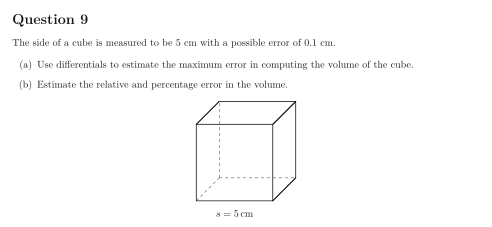
Original worksheet page 1: question and worked solution for 4-12-009
Show solutionHide solution

Question 9 - Solution

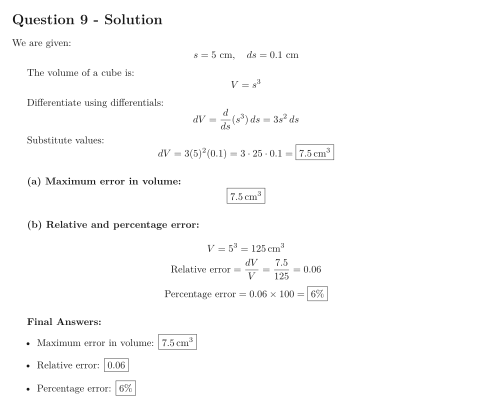
We are given: s=5 cm,ds=0.1 cms = 5 \text{ cm}, \quad ds = 0.1 \text{ cm}

The volume of a cube is: V=s3V = s^3

Differentiate using differentials: dV=dds(s3)ds=3s2dsdV = \frac{d}{ds}(s^3)\, ds = 3s^2\, ds

Substitute values: dV=3(5)2(0.1)=3⋅25⋅0.1=7.5cm3dV = 3(5)^2(0.1) = 3 \cdot 25 \cdot 0.1 = \boxed{7.5 \, \text{cm}^3}

(a) Maximum error in volume: 7.5cm3\boxed{7.5 \, \text{cm}^3}

(b) Relative and percentage error:

V=53=125cm3V = 5^3 = 125 \, \text{cm}^3 Relative error=dVV=7.5125=0.06\text{Relative error} = \frac{dV}{V} = \frac{7.5}{125} = 0.06 Percentage error=0.06×100=6%\text{Percentage error} = 0.06 \times 100 = \boxed{6\%}

Final Answers:

  • Maximum error in volume: 7.5cm3\boxed{7.5 \, \text{cm}^3}

  • Relative error: 0.06\boxed{0.06}

  • Percentage error: 6%\boxed{6\%}

Original worksheet page 2: question and worked solution for 4-12-009

Original worksheet layout. Use Enlarge or open the PDF for a closer view.