Question 4
Problem
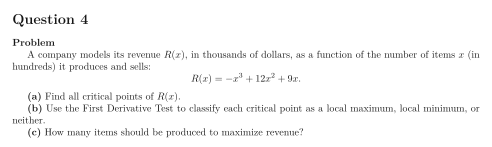
A company models its revenue , in thousands of dollars, as a function of the number of items (in hundreds) it produces and sells:
(a) Find all critical points of .
(b) Use the First Derivative Test to classify each critical point as a local maximum, local minimum, or neither.
(c) How many items should be produced to maximize revenue?
Show solutionHide solution
Question 4 - Solution
We are given
(a) Find the derivative:
Set :
Using the quadratic formula:
Critical points:
(b) First Derivative Test
Since is a downward-opening parabola, it is negative outside its roots and positive between them.
At , changes from negative to positive, so has a local minimum.
At , changes from positive to negative, so has a local maximum.
(c) Maximizing revenue
Revenue is maximized at
Since is measured in hundreds of items, this corresponds to
Graph of with critical points marked
See the diagram in the original worksheet below.
