Critical Points — Question 8

PDF ↗

Question 8

Problem:

A ball is launched vertically upward, and its height in meters at time tt seconds is modeled by: h(t)=−5t2+20t+1h(t) = -5t^2 + 20t + 1

  • (a) Find all critical points of the function h(t)h(t).

  • (b) Use the First Derivative Test to classify each critical point.

  • (c) What is the maximum height reached by the ball and at what time?
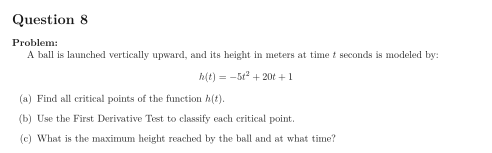
Original worksheet page 1: question and worked solution for 4-2-008
Show solutionHide solution

Question 8 - Solution

(a) Find critical points:

Take the derivative: h′(t)=−10t+20h'(t) = -10t + 20

Set h′(t)=0h'(t) = 0: −10t+20=0⇒t=2-10t + 20 = 0 \Rightarrow t = 2

Critical point: t=2\boxed{t = 2}

(b) First Derivative Test:

For t<2t < 2: pick t=1t = 1, h′(1)=−10(1)+20=10>0h'(1) = -10(1) + 20 = 10 > 0

For t>2t > 2: pick t=3t = 3, h′(3)=−10(3)+20=−10<0h'(3) = -10(3) + 20 = -10 < 0

Since h′(t)h'(t) changes from positive to negative at t=2t = 2, this is a local maximum.

(c) Maximum Height:

Substitute t=2t = 2 into h(t)h(t): h(2)=−5(4)+20(2)+1=−20+40+1=21h(2) = -5(4) + 20(2) + 1 = -20 + 40 + 1 = 21

Answer: The maximum height is 21 meters\boxed{21 \text{ meters}}, reached at t=2 seconds\boxed{t = 2 \text{ seconds}}.

Graph of the Trajectory:

See the diagram in the original worksheet below.

Original worksheet page 2: question and worked solution for 4-2-008

Original worksheet layout. Use Enlarge or open the PDF for a closer view.