Minimum and Maximum Values — Question 1

PDF ↗

Question 1

Let: f(x)=2x3−9x2+12x+1f(x) = 2x^3 - 9x^2 + 12x + 1

(a) Find the critical points of f(x)f(x).

(b) Use the second derivative test to determine whether each critical point is a local minimum, maximum, or neither.
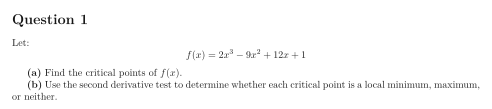
Original worksheet page 1: question and worked solution for 4-3-001
Show solutionHide solution

Question 1 - Solution

We are given: f(x)=2x3−9x2+12x+1f(x) = 2x^3 - 9x^2 + 12x + 1

(a) First derivative: f′(x)=6x2−18x+12=6(x2−3x+2)=6(x−1)(x−2)f'(x) = 6x^2 - 18x + 12 = 6(x^2 - 3x + 2) = 6(x - 1)(x - 2)

Critical points: x=1,2x = 1, 2

(b) Use the second derivative: f″(x)=ddx(f′(x))=12x−18f''(x) = \frac{d}{dx}(f'(x)) = 12x - 18

Evaluate at each critical point: f″(1)=12(1)−18=−6⇒local maximum at x=1f''(1) = 12(1) - 18 = -6 \;\Rightarrow\; \text{local maximum at } x = 1 f″(2)=12(2)−18=6⇒local minimum at x=2f''(2) = 12(2) - 18 = 6 \;\Rightarrow\; \text{local minimum at } x = 2

Answer: Local maximum at x=1\text{Local maximum at } \boxed{x = 1} Local minimum at x=2\text{Local minimum at } \boxed{x = 2}

Graph of f(x)f(x)

See the diagram in the original worksheet below.

Original worksheet page 2: question and worked solution for 4-3-001

Original worksheet layout. Use Enlarge or open the PDF for a closer view.