The Shape of a Graph, Part I — Question 4

PDF ↗

Question 4

Problem:

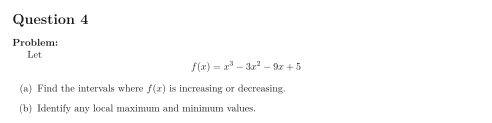
Let f(x)=x3−3x2−9x+5f(x) = x^3 - 3x^2 - 9x + 5

  • (a) Find the intervals where f(x)f(x) is increasing or decreasing.

  • (b) Identify any local maximum and minimum values.

Original worksheet page 1: question and worked solution for 4-5-004
Show solutionHide solution

Question 4 - Solution

We are given: f(x)=x3−3x2−9x+5f(x) = x^3 - 3x^2 - 9x + 5

(a) Find the first derivative: f′(x)=3x2−6x−9f'(x) = 3x^2 - 6x - 9

Set f′(x)=0f'(x) = 0 to find critical points: 3x2−6x−9=0⇒x2−2x−3=03x^2 - 6x - 9 = 0 \quad \Rightarrow \quad x^2 - 2x - 3 = 0 (x−3)(x+1)=0⇒x=−1,3(x - 3)(x + 1) = 0 \quad \Rightarrow \quad x = -1,\ 3

Test intervals for sign of f′(x)f'(x):

For x<−1x < -1: pick x=−2x = -2: f′(−2)=3(−2)2−6(−2)−9=12+12−9=15>0f'(-2) = 3(-2)^2 - 6(-2) - 9 = 12 + 12 - 9 = 15 > 0

For −1<x<3-1 < x < 3: pick x=0x = 0: f′(0)=−9<0f'(0) = -9 < 0

For x>3x > 3: pick x=4x = 4: f′(4)=3(16)−6(4)−9=48−24−9=15>0f'(4) = 3(16) - 6(4) - 9 = 48 - 24 - 9 = 15 > 0

Conclusion: f(x) is increasing on (−∞,−1)∪(3,∞)f(x) is decreasing on (−1,3)\begin{aligned} &f(x) \text{ is increasing on } (-\infty, -1) \cup (3, \infty) \\ &f(x) \text{ is decreasing on } (-1, 3) \end{aligned}

(b) Local Extrema:

At x=−1x = -1: changes from increasing to decreasing → local maximum At x=3x = 3: changes from decreasing to increasing → local minimum

Evaluate f(x)f(x) at critical points: f(−1)=(−1)3−3(−1)2−9(−1)+5=−1−3+9+5=10f(-1) = (-1)^3 - 3(-1)^2 - 9(-1) + 5 = -1 - 3 + 9 + 5 = 10 f(3)=27−27−27+5=−22f(3) = 27 - 27 - 27 + 5 = -22

Local Maximum: (−1,10)\boxed{( -1,\ 10 )}

Local Minimum: (3,−22)\boxed{( 3,\ -22 )}

Graph of f(x)=x3−3x2−9x+5f(x) = x^3 - 3x^2 - 9x + 5:

See the diagram in the original worksheet below.
Original worksheet page 2: question and worked solution for 4-5-004

Original worksheet layout. Use Enlarge or open the PDF for a closer view.