The Shape of a Graph, Part II — Question 2

PDF ↗

Question 2

Let f(x)=x4−4x3f(x) = x^4 - 4x^3

(a) Find the intervals where the graph of ff is concave up and concave down.

(b) Identify any inflection points.
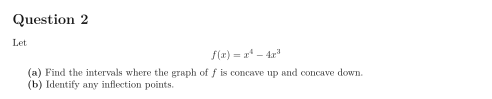
Original worksheet page 1: question and worked solution for 4-6-002
Show solutionHide solution

Question 2 - Solution

We are given f(x)=x4−4x3f(x) = x^4 - 4x^3

First derivative

f′(x)=4x3−12x2f'(x) = 4x^3 - 12x^2

Second derivative

f″(x)=12x2−24x=12x(x−2)f''(x) = 12x^2 - 24x = 12x(x - 2)

(a) Concavity

Setting f″(x)=0f''(x) = 0 gives the critical values x=0andx=2.x = 0 \quad \text{and} \quad x = 2.

For x<0x < 0, the second derivative is positive, so the graph is concave up. For 0<x<20 < x < 2, the second derivative is negative, so the graph is concave down. For x>2x > 2, the second derivative is positive, so the graph is concave up.

Concave up on (−∞,0)∪(2,∞)\boxed{(-\infty, 0) \cup (2, \infty)}

Concave down on (0,2)\boxed{(0, 2)}

(b) Inflection points

Because the concavity changes at both x=0x = 0 and x=2x = 2, inflection points occur at these values.

f(0)=0f(2)=16−32=−16f(0) = 0 \qquad f(2) = 16 - 32 = -16

Inflection points at (0,0)and(2,−16)\boxed{(0, 0) \quad \text{and} \quad (2, -16)}

Graph of f(x)f(x)

See the diagram in the original worksheet below.

Original worksheet page 2: question and worked solution for 4-6-002

Original worksheet layout. Use Enlarge or open the PDF for a closer view.