The Mean Value Theorem — Question 3

PDF ↗

Question 2

Problem:

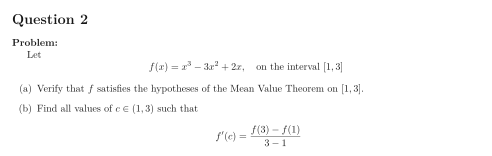
Let f(x)=x3−3x2+2x,on the interval [1,3]f(x) = x^3 - 3x^2 + 2x, \quad \text{on the interval } [1, 3]

  • (a) Verify that ff satisfies the hypotheses of the Mean Value Theorem on [1,3][1, 3].

  • (b) Find all values of c∈(1,3)c \in (1, 3) such that f′(c)=f(3)−f(1)3−1f'(c) = \frac{f(3) - f(1)}{3 - 1}

Original worksheet page 1: question and worked solution for 4-7-003
Show solutionHide solution

Question 2 - Solution

We are given: f(x)=x3−3x2+2xf(x) = x^3 - 3x^2 + 2x

(a) Hypotheses of the MVT:

- f(x)f(x) is a polynomial ⇒ continuous on [1,3][1, 3] - f(x)f(x) is differentiable on (1,3)(1, 3)

✅ Therefore, MVT applies.

(b) Apply the MVT:

Compute: f(3)=27−27+6=6,f(1)=1−3+2=0f(3) = 27 - 27 + 6 = 6, \quad f(1) = 1 - 3 + 2 = 0 Average rate of change=6−03−1=62=3\text{Average rate of change} = \frac{6 - 0}{3 - 1} = \frac{6}{2} = 3

Compute derivative: f′(x)=3x2−6x+2f'(x) = 3x^2 - 6x + 2

Set f′(c)=3f'(c) = 3: 3c2−6c+2=3⇒3c2−6c−1=03c^2 - 6c + 2 = 3 \quad \Rightarrow \quad 3c^2 - 6c - 1 = 0

Solve: c=6±(−6)2−4(3)(−1)2(3)=6±36+126=6±486=6±436=3±233c = \frac{6 \pm \sqrt{(-6)^2 - 4(3)(-1)}}{2(3)} = \frac{6 \pm \sqrt{36 + 12}}{6} = \frac{6 \pm \sqrt{48}}{6} = \frac{6 \pm 4\sqrt{3}}{6} = \frac{3 \pm 2\sqrt{3}}{3}

Answer: c=3±233Only the value(s) in (1,3) are valid.\boxed{c = \frac{3 \pm 2\sqrt{3}}{3}} \quad \text{Only the value(s) in } (1, 3) \text{ are valid.}

Since: 3−233≈0.845<1(not valid)\frac{3 - 2\sqrt{3}}{3} \approx 0.845 < 1 \quad \text{(not valid)} 3+233≈2.155∈(1,3)\frac{3 + 2\sqrt{3}}{3} \approx 2.155 \in (1, 3)

Final answer: c=3+233\boxed{c = \frac{3 + 2\sqrt{3}}{3}}

Graph of f(x)=x3−3x2+2xf(x) = x^3 - 3x^2 + 2x on [1,3][1, 3]:

See the diagram in the original worksheet below.
Original worksheet page 2: question and worked solution for 4-7-003

Original worksheet layout. Use Enlarge or open the PDF for a closer view.