The Mean Value Theorem — Question 6

PDF ↗

Question 6

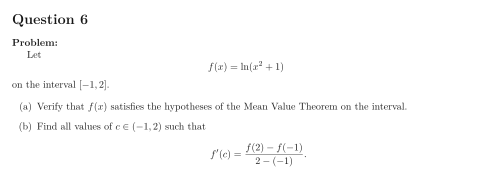
Problem:

Let f(x)=ln⁡(x2+1)f(x) = \ln(x^2 + 1) on the interval [−1,2][-1, 2].

  • (a) Verify that f(x)f(x) satisfies the hypotheses of the Mean Value Theorem on the interval.

  • (b) Find all values of c∈(−1,2)c \in (-1, 2) such that f′(c)=f(2)−f(−1)2−(−1).f'(c) = \frac{f(2) - f(-1)}{2 - (-1)}.

Original worksheet page 1: question and worked solution for 4-7-006
Show solutionHide solution

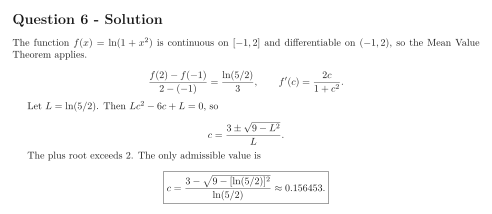
Question 6 - Solution

The function f(x)=ln⁡(1+x2)f(x)=\ln(1+x^2) is continuous on [−1,2][-1,2] and differentiable on (−1,2)(-1,2), so the Mean Value Theorem applies.

f(2)−f(−1)2−(−1)=ln⁡(5/2)3,f′(c)=2c1+c2.\frac{f(2)-f(-1)}{2-(-1)}=\frac{\ln(5/2)}3,\qquad f'(c)=\frac{2c}{1+c^2}.

Let L=ln⁡(5/2)L=\ln(5/2). Then Lc2−6c+L=0Lc^2-6c+L=0, so

c=3±9−L2L.c=\frac{3\pm\sqrt{9-L^2}}{L}.

The plus root exceeds 22. The only admissible value is

c=3−9−[ln⁡(5/2)]2ln⁡(5/2)≈0.156453.\boxed{c=\frac{3-\sqrt{9-[\ln(5/2)]^2}}{\ln(5/2)}\approx 0.156453.}

Original worksheet page 2: question and worked solution for 4-7-006

Original worksheet layout. Use Enlarge or open the PDF for a closer view.