Indefinite Integrals — Question 8

PDF ↗

Question 8

Find the general antiderivative of ∫(ln(x+1+x2)+x21+x2)dx.\int \left( \ln\!\left(x+\sqrt{1+x^2}\right) + \frac{x^2}{\sqrt{1+x^2}} \right)\,dx.

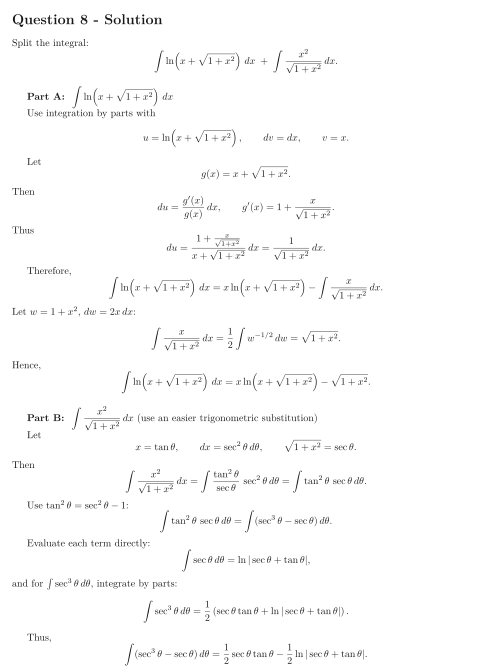
Original worksheet page 1: question and worked solution for 5-1-008
Show solutionHide solution

Question 8 - Solution

Split the integral: ∫ln⁡(x+1+x2)dx+∫x21+x2dx.\int \ln\!\left(x+\sqrt{1+x^2}\right)\,dx \;+\; \int \frac{x^2}{\sqrt{1+x^2}}\,dx.

Part A: ∫ln⁡(x+1+x2)dx\displaystyle \int \ln\!\left(x+\sqrt{1+x^2}\right)\,dx

Use integration by parts with u=ln⁡(x+1+x2),dv=dx,v=x.u=\ln\!\left(x+\sqrt{1+x^2}\right),\qquad dv=dx,\qquad v=x.

Let g(x)=x+1+x2.g(x)=x+\sqrt{1+x^2}. Then du=g′(x)g(x)dx,g′(x)=1+x1+x2.du=\frac{g'(x)}{g(x)}\,dx, \qquad g'(x)=1+\frac{x}{\sqrt{1+x^2}}. Thus du=1+x1+x2x+1+x2dx=11+x2dx.du=\frac{1+\frac{x}{\sqrt{1+x^2}}}{x+\sqrt{1+x^2}}\,dx =\frac{1}{\sqrt{1+x^2}}\,dx.

Therefore, ∫ln⁡(x+1+x2)dx=xln⁡(x+1+x2)−∫x1+x2dx.\int \ln\!\left(x+\sqrt{1+x^2}\right)\,dx = x\ln\!\left(x+\sqrt{1+x^2}\right) -\int \frac{x}{\sqrt{1+x^2}}\,dx. Let w=1+x2w=1+x^2, dw=2xdxdw=2x\,dx: ∫x1+x2dx=12∫w−1/2dw=1+x2.\int \frac{x}{\sqrt{1+x^2}}\,dx =\frac{1}{2}\int w^{-1/2}\,dw =\sqrt{1+x^2}. Hence, ∫ln⁡(x+1+x2)dx=xln⁡(x+1+x2)−1+x2.\int \ln\!\left(x+\sqrt{1+x^2}\right)\,dx = x\ln\!\left(x+\sqrt{1+x^2}\right)-\sqrt{1+x^2}.

Part B: ∫x21+x2dx\displaystyle \int \frac{x^2}{\sqrt{1+x^2}}\,dx (use an easier trigonometric substitution)

Let x=tan⁡θ,dx=sec⁡2θdθ,1+x2=sec⁡θ.x=\tan\theta, \qquad dx=\sec^2\theta\,d\theta, \qquad \sqrt{1+x^2}=\sec\theta. Then ∫x21+x2dx=∫tan⁡2θsec⁡θsec⁡2θdθ=∫tan⁡2θsec⁡θdθ.\int \frac{x^2}{\sqrt{1+x^2}}\,dx = \int \frac{\tan^2\theta}{\sec\theta}\,\sec^2\theta\,d\theta = \int \tan^2\theta\,\sec\theta\,d\theta.

Use tan⁡2θ=sec⁡2θ−1\tan^2\theta=\sec^2\theta-1: ∫tan⁡2θsec⁡θdθ=∫(sec⁡3θ−sec⁡θ)dθ.\int \tan^2\theta\,\sec\theta\,d\theta = \int (\sec^3\theta-\sec\theta)\,d\theta.

Evaluate each term directly: ∫sec⁡θdθ=ln⁡|sec⁡θ+tan⁡θ|,\int \sec\theta\,d\theta=\ln|\sec\theta+\tan\theta|, and for ∫sec⁡3θdθ\int\sec^3\theta\,d\theta, integrate by parts: ∫sec⁡3θdθ=12(secθtanθ+ln|secθ+tanθ|).\int \sec^3\theta\,d\theta =\frac{1}{2}\left(\sec\theta\tan\theta +\ln|\sec\theta+\tan\theta|\right).

Thus, ∫(sec⁡3θ−sec⁡θ)dθ=12sec⁡θtan⁡θ−12ln⁡|sec⁡θ+tan⁡θ|.\int (\sec^3\theta-\sec\theta)\,d\theta = \frac{1}{2}\sec\theta\tan\theta -\frac{1}{2}\ln|\sec\theta+\tan\theta|.

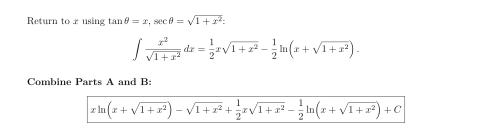
Return to xx using tan⁡θ=x\tan\theta=x, sec⁡θ=1+x2\sec\theta=\sqrt{1+x^2}: ∫x21+x2dx=12x1+x2−12ln⁡(x+1+x2).\int \frac{x^2}{\sqrt{1+x^2}}\,dx = \frac{1}{2}x\sqrt{1+x^2} -\frac{1}{2}\ln\!\left(x+\sqrt{1+x^2}\right).

Combine Parts A and B: xln⁡(x+1+x2)−1+x2+12x1+x2−12ln⁡(x+1+x2)+C\boxed{ x\ln\!\left(x+\sqrt{1+x^2}\right) -\sqrt{1+x^2} +\frac{1}{2}x\sqrt{1+x^2} -\frac{1}{2}\ln\!\left(x+\sqrt{1+x^2}\right) +C }

Original worksheet page 2: question and worked solution for 5-1-008
Original worksheet page 3: question and worked solution for 5-1-008

Original worksheet layout. Use Enlarge or open the PDF for a closer view.