Computing Indefinite Integrals — Question 5

PDF ↗

Question 5

Evaluate ∫x2x2+1dx.\int \frac{x^2}{\sqrt{x^2+1}}\,dx.

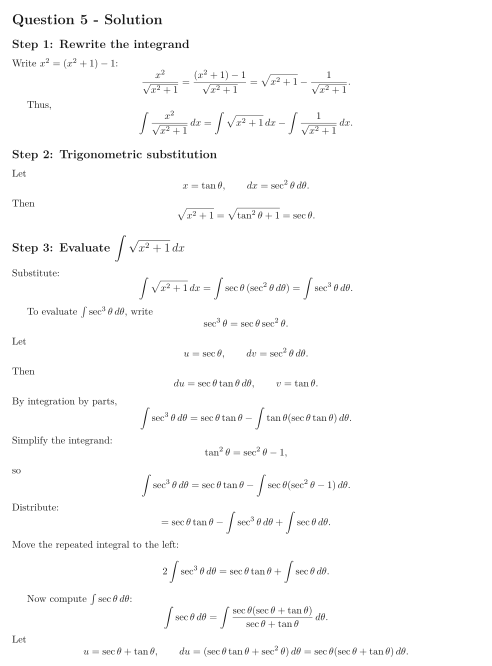
Original worksheet page 1: question and worked solution for 5-2-005
Show solutionHide solution

Question 5 - Solution

Step 1: Rewrite the integrand

Write x2=(x2+1)−1x^2=(x^2+1)-1: x2x2+1=(x2+1)−1x2+1=x2+1−1x2+1.\frac{x^2}{\sqrt{x^2+1}} =\frac{(x^2+1)-1}{\sqrt{x^2+1}} =\sqrt{x^2+1}-\frac{1}{\sqrt{x^2+1}}.

Thus, ∫x2x2+1dx=∫x2+1dx−∫1x2+1dx.\int \frac{x^2}{\sqrt{x^2+1}}\,dx =\int \sqrt{x^2+1}\,dx -\int \frac{1}{\sqrt{x^2+1}}\,dx.

Step 2: Trigonometric substitution

Let x=tan⁡θ,dx=sec⁡2θdθ.x=\tan\theta, \qquad dx=\sec^2\theta\,d\theta. Then x2+1=tan⁡2θ+1=sec⁡θ.\sqrt{x^2+1}=\sqrt{\tan^2\theta+1}=\sec\theta.

Step 3: Evaluate ∫x2+1dx\displaystyle \int \sqrt{x^2+1}\,dx

Substitute: ∫x2+1dx=∫sec⁡θ(sec⁡2θdθ)=∫sec⁡3θdθ.\int \sqrt{x^2+1}\,dx =\int \sec\theta\,(\sec^2\theta\,d\theta) =\int \sec^3\theta\,d\theta.

To evaluate ∫sec⁡3θdθ\int \sec^3\theta\,d\theta, write sec⁡3θ=sec⁡θsec⁡2θ.\sec^3\theta=\sec\theta\sec^2\theta. Let u=sec⁡θ,dv=sec⁡2θdθ.u=\sec\theta, \qquad dv=\sec^2\theta\,d\theta. Then du=sec⁡θtan⁡θdθ,v=tan⁡θ.du=\sec\theta\tan\theta\,d\theta, \qquad v=\tan\theta. By integration by parts, ∫sec⁡3θdθ=sec⁡θtan⁡θ−∫tan⁡θ(sec⁡θtan⁡θ)dθ.\int \sec^3\theta\,d\theta =\sec\theta\tan\theta-\int \tan\theta(\sec\theta\tan\theta)\,d\theta. Simplify the integrand: tan⁡2θ=sec⁡2θ−1,\tan^2\theta=\sec^2\theta-1, so ∫sec⁡3θdθ=sec⁡θtan⁡θ−∫sec⁡θ(sec⁡2θ−1)dθ.\int \sec^3\theta\,d\theta =\sec\theta\tan\theta-\int \sec\theta(\sec^2\theta-1)\,d\theta. Distribute: =sec⁡θtan⁡θ−∫sec⁡3θdθ+∫sec⁡θdθ.=\sec\theta\tan\theta-\int \sec^3\theta\,d\theta+\int \sec\theta\,d\theta. Move the repeated integral to the left: 2∫sec⁡3θdθ=sec⁡θtan⁡θ+∫sec⁡θdθ.2\int \sec^3\theta\,d\theta =\sec\theta\tan\theta+\int \sec\theta\,d\theta.

Now compute ∫sec⁡θdθ\int \sec\theta\,d\theta: ∫sec⁡θdθ=∫sec⁡θ(sec⁡θ+tan⁡θ)sec⁡θ+tan⁡θdθ.\int \sec\theta\,d\theta =\int \frac{\sec\theta(\sec\theta+\tan\theta)}{\sec\theta+\tan\theta}\,d\theta. Let u=sec⁡θ+tan⁡θ,du=(sec⁡θtan⁡θ+sec⁡2θ)dθ=sec⁡θ(sec⁡θ+tan⁡θ)dθ.u=\sec\theta+\tan\theta, \qquad du=(\sec\theta\tan\theta+\sec^2\theta)\,d\theta =\sec\theta(\sec\theta+\tan\theta)\,d\theta. Hence, ∫sec⁡θdθ=ln⁡|sec⁡θ+tan⁡θ|+C.\int \sec\theta\,d\theta =\ln|\sec\theta+\tan\theta|+C.

Substitute back: 2∫sec⁡3θdθ=sec⁡θtan⁡θ+ln⁡|sec⁡θ+tan⁡θ|.2\int \sec^3\theta\,d\theta =\sec\theta\tan\theta+\ln|\sec\theta+\tan\theta|. Therefore, ∫sec⁡3θdθ=12(secθtanθ+ln|secθ+tanθ|)+C.\int \sec^3\theta\,d\theta =\frac12\left(\sec\theta\tan\theta+\ln|\sec\theta+\tan\theta|\right)+C.

Returning to xx: sec⁡θ=x2+1,tan⁡θ=x.\sec\theta=\sqrt{x^2+1}, \qquad \tan\theta=x. Thus, ∫x2+1dx=12(xx2+1+ln(x+x2+1))+C.\int \sqrt{x^2+1}\,dx =\frac12\left( x\sqrt{x^2+1} +\ln\!\left(x+\sqrt{x^2+1}\right) \right)+C.

Step 4: Evaluate ∫1x2+1dx\displaystyle \int \frac{1}{\sqrt{x^2+1}}\,dx

Substitute again: ∫1x2+1dx=∫1sec⁡θ(sec⁡2θdθ)=∫sec⁡θdθ.\int \frac{1}{\sqrt{x^2+1}}\,dx =\int \frac{1}{\sec\theta}(\sec^2\theta\,d\theta) =\int \sec\theta\,d\theta. From above, ∫sec⁡θdθ=ln⁡|sec⁡θ+tan⁡θ|+C=ln⁡(x+x2+1)+C.\int \sec\theta\,d\theta =\ln|\sec\theta+\tan\theta|+C =\ln\!\left(x+\sqrt{x^2+1}\right)+C.

Step 5: Combine results

∫x2x2+1dx=12(xx2+1+ln(x+x2+1))−ln⁡(x+x2+1)+C.\int \frac{x^2}{\sqrt{x^2+1}}\,dx = \frac12\left( x\sqrt{x^2+1} +\ln\!\left(x+\sqrt{x^2+1}\right) \right) - \ln\!\left(x+\sqrt{x^2+1}\right) + C. Combine logarithms: =x2x2+1−12ln⁡(x+x2+1)+C.=\frac{x}{2}\sqrt{x^2+1} -\frac12\ln\!\left(x+\sqrt{x^2+1}\right) + C.

Final Answer: ∫x2x2+1dx=x2x2+1−12ln⁡(x+x2+1)+C\boxed{ \int \frac{x^2}{\sqrt{x^2+1}}\,dx = \frac{x}{2}\sqrt{x^2+1} -\frac12\ln\!\left(x+\sqrt{x^2+1}\right) + C }

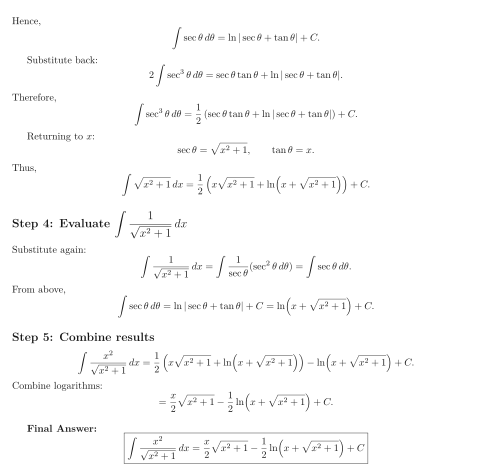
Original worksheet page 2: question and worked solution for 5-2-005
Original worksheet page 3: question and worked solution for 5-2-005

Original worksheet layout. Use Enlarge or open the PDF for a closer view.