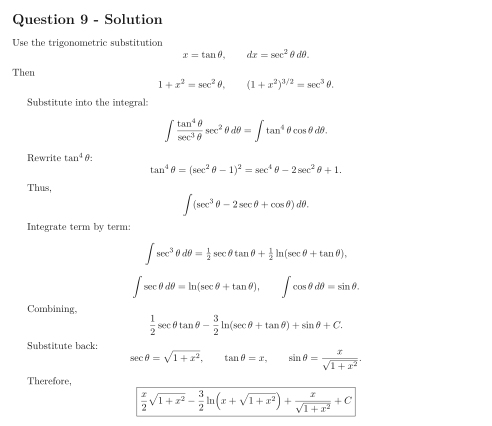
Question 9 Evaluate the integral ∫x4(1+x2)3/2dx.\int \frac{x^4}{(1+x^2)^{3/2}}\,dx. Show solutionHide solution+Question 9 - Solution Use the trigonometric substitution x=tanθ,dx=sec2θdθ.x=\tan\theta, \qquad dx=\sec^2\theta\,d\theta. Then 1+x2=sec2θ,(1+x2)3/2=sec3θ.1+x^2=\sec^2\theta, \qquad (1+x^2)^{3/2}=\sec^3\theta. Substitute into the integral: ∫tan4θsec3θsec2θdθ=∫tan4θcosθdθ.\int \frac{\tan^4\theta}{\sec^3\theta}\sec^2\theta\,d\theta = \int \tan^4\theta\cos\theta\,d\theta. Rewrite tan4θ\tan^4\theta: tan4θ=(sec2θ−1)2=sec4θ−2sec2θ+1.\tan^4\theta = (\sec^2\theta-1)^2 = \sec^4\theta - 2\sec^2\theta + 1. Thus, ∫(sec3θ−2secθ+cosθ)dθ.\int (\sec^3\theta - 2\sec\theta + \cos\theta)\,d\theta. Integrate term by term: ∫sec3θdθ=12secθtanθ+12ln(secθ+tanθ),\int \sec^3\theta\,d\theta = \tfrac12\sec\theta\tan\theta + \tfrac12\ln(\sec\theta+\tan\theta), ∫secθdθ=ln(secθ+tanθ),∫cosθdθ=sinθ.\int \sec\theta\,d\theta = \ln(\sec\theta+\tan\theta), \qquad \int \cos\theta\,d\theta = \sin\theta. Combining, 12secθtanθ−32ln(secθ+tanθ)+sinθ+C.\frac12\sec\theta\tan\theta - \frac32\ln(\sec\theta+\tan\theta) + \sin\theta + C. Substitute back: secθ=1+x2,tanθ=x,sinθ=x1+x2.\sec\theta=\sqrt{1+x^2}, \qquad \tan\theta=x, \qquad \sin\theta=\frac{x}{\sqrt{1+x^2}}. Therefore, x21+x2−32ln(x+1+x2)+x1+x2+C\boxed{ \frac{x}{2}\sqrt{1+x^2} - \frac{3}{2}\ln\!\left(x+\sqrt{1+x^2}\right) + \frac{x}{\sqrt{1+x^2}} + C }