Area Between Curves — Question 3

PDF ↗

Question 3

Find the exact area of the region between the curves y=sin⁡xandy=1−cos⁡x,y=\sin x \quad\text{and}\quad y=1-\cos x, between x=0x=0 and x=πx=\pi.

See the diagram in the original worksheet below.

The shaded region is the area to be found.

Original worksheet page 1: question and worked solution for 6-2-003
Show solutionHide solution

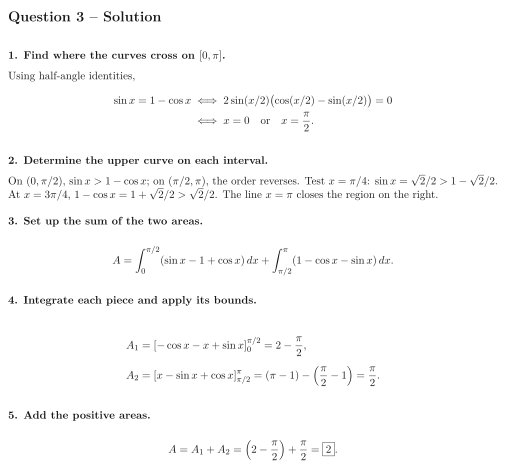
Question 3 – Solution

1. Find where the curves cross on [0,π][0,\pi].

Using half-angle identities, sin⁡x=1−cos⁡x⇔2sin⁡(x/2)(cos⁡(x/2)−sin⁡(x/2))=0⇔x=0orx=π2.\begin{align*} \sin x=1-\cos x &\iff 2\sin(x/2)\bigl(\cos(x/2)-\sin(x/2)\bigr)=0\\ &\iff x=0\quad\text{or}\quad x=\frac\pi2. \end{align*}

2. Determine the upper curve on each interval.

On (0,π/2)(0,\pi/2), sin⁡x>1−cos⁡x\sin x>1-\cos x; on (π/2,π)(\pi/2,\pi), the order reverses. Test x=π/4x=\pi/4: sin⁡x=2/2>1−2/2\sin x=\sqrt2/2>1-\sqrt2/2. At x=3π/4x=3\pi/4, 1−cos⁡x=1+2/2>2/21-\cos x=1+\sqrt2/2>\sqrt2/2. The line x=πx=\pi closes the region on the right.

3. Set up the sum of the two areas.

A=∫0π/2(sin⁡x−1+cos⁡x)dx+∫π/2π(1−cos⁡x−sin⁡x)dx.A=\int_0^{\pi/2}(\sin x-1+\cos x)\,dx +\int_{\pi/2}^{\pi}(1-\cos x-\sin x)\,dx.

4. Integrate each piece and apply its bounds.

A1=[−cosx−x+sinx]0π/2=2−π2,A2=[x−sinx+cosx]π/2π=(π−1)−(π2−1)=π2.\begin{align*} A_1&=\left[-\cos x-x+\sin x\right]_0^{\pi/2} =2-\frac\pi2,\\[6pt] A_2&=\left[x-\sin x+\cos x\right]_{\pi/2}^{\pi} =(\pi-1)-\left(\frac\pi2-1\right)=\frac\pi2. \end{align*}

5. Add the positive areas.

A=A1+A2=(2−π2)+π2=2.A=A_1+A_2=\left(2-\frac\pi2\right)+\frac\pi2=\boxed{2}.

Original worksheet page 2: question and worked solution for 6-2-003

Original worksheet layout. Use Enlarge or open the PDF for a closer view.