Question 10
A vertical spring attached to a ceiling has natural length m and spring constant N/m. An external agent stretches it downward from length m to m.
Find the work done by the spring during this motion.
See the diagram in the original worksheet below.
The shaded area represents negative work done by the spring.

Show solutionHide solution
Question 10 – Solution
1. Define displacement from natural length.
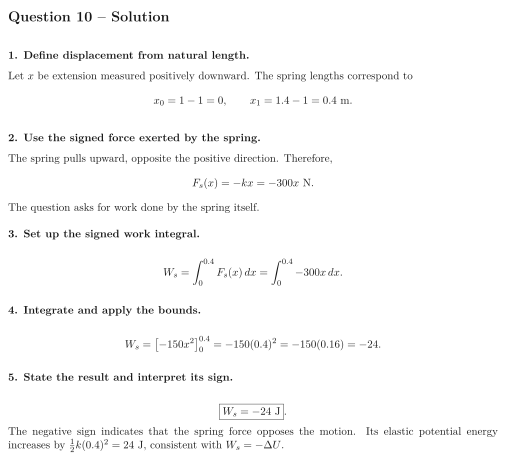
Let be extension measured positively downward. The spring lengths correspond to
2. Use the signed force exerted by the spring.
The spring pulls upward, opposite the positive direction. Therefore,The question asks for work done by the spring itself.
3. Set up the signed work integral.
4. Integrate and apply the bounds.
5. State the result and interpret its sign.
The negative sign indicates that the spring force opposes the motion. Its elastic potential energy increases by J, consistent with .