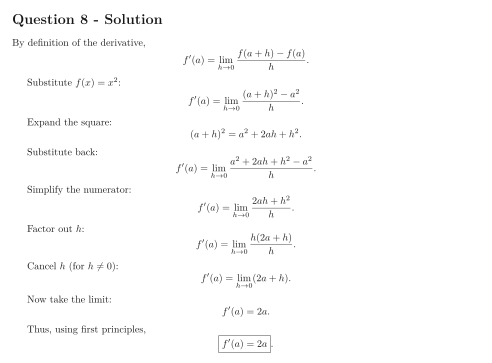
Question 8 Prove from first principles that if f(x)=x2,f(x)=x^2, then f′(a)=2a.f'(a)=2a. Show solutionHide solution+Question 8 - Solution By definition of the derivative, f′(a)=limh→0f(a+h)−f(a)h.f'(a)=\lim_{h\to 0}\frac{f(a+h)-f(a)}{h}. Substitute f(x)=x2f(x)=x^2: f′(a)=limh→0(a+h)2−a2h.f'(a)=\lim_{h\to 0}\frac{(a+h)^2-a^2}{h}. Expand the square: (a+h)2=a2+2ah+h2.(a+h)^2=a^2+2ah+h^2. Substitute back: f′(a)=limh→0a2+2ah+h2−a2h.f'(a)=\lim_{h\to 0}\frac{a^2+2ah+h^2-a^2}{h}. Simplify the numerator: f′(a)=limh→02ah+h2h.f'(a)=\lim_{h\to 0}\frac{2ah+h^2}{h}. Factor out hh: f′(a)=limh→0h(2a+h)h.f'(a)=\lim_{h\to 0}\frac{h(2a+h)}{h}. Cancel hh (for h≠0h\neq 0): f′(a)=limh→0(2a+h).f'(a)=\lim_{h\to 0}(2a+h). Now take the limit: f′(a)=2a.f'(a)=2a. Thus, using first principles, f′(a)=2a.\boxed{f'(a)=2a}.